OBJECT LESSON
Meaningful Pasts
Stewarded into the Present:
It’s Up to Us
Sháńdíín Brown
Image
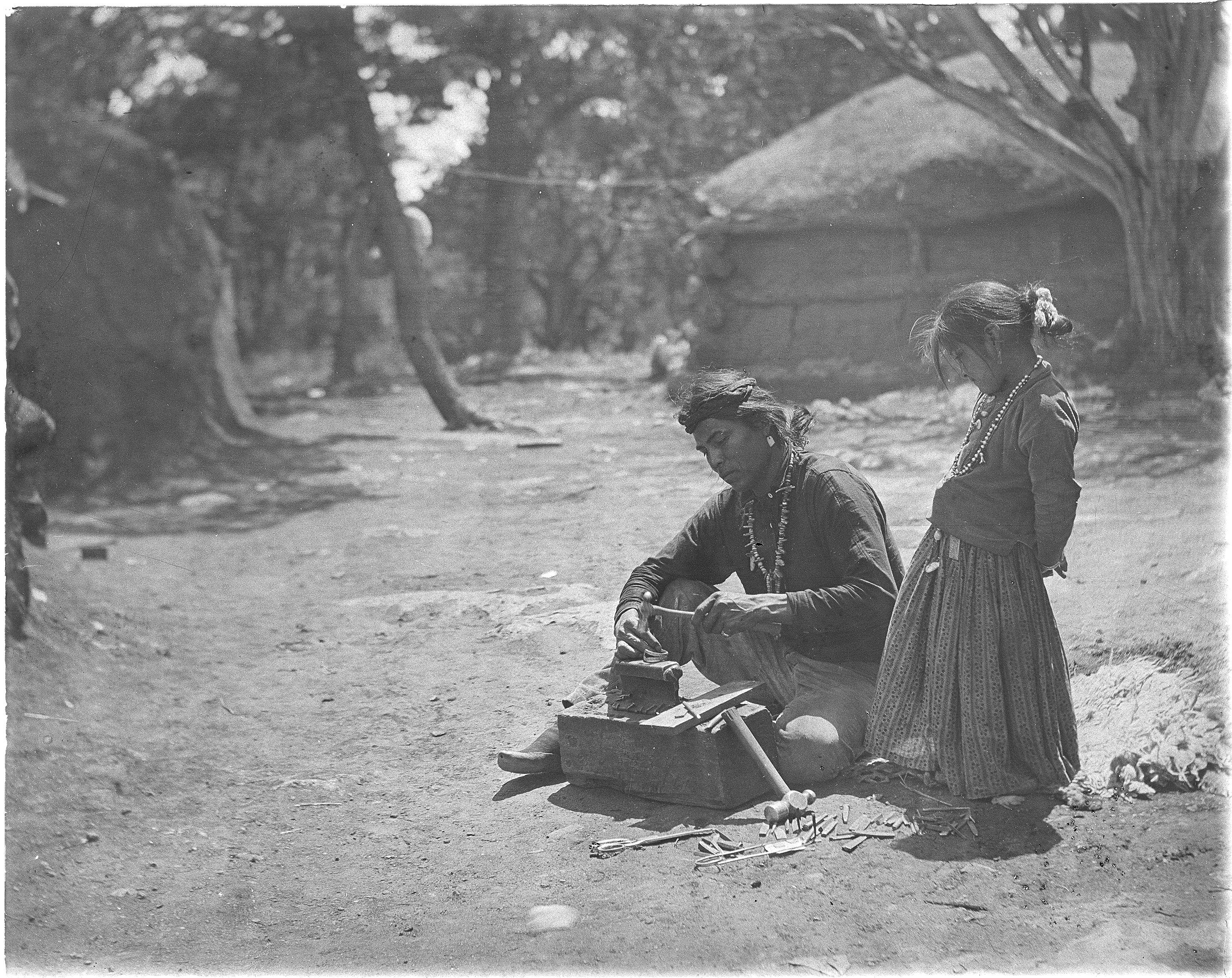
FIG. 3
Carl Moon (1878–1948), The Silversmith, 1907–1914.
National Museum of the American Indian, Smithsonian Institution N31720.
Image
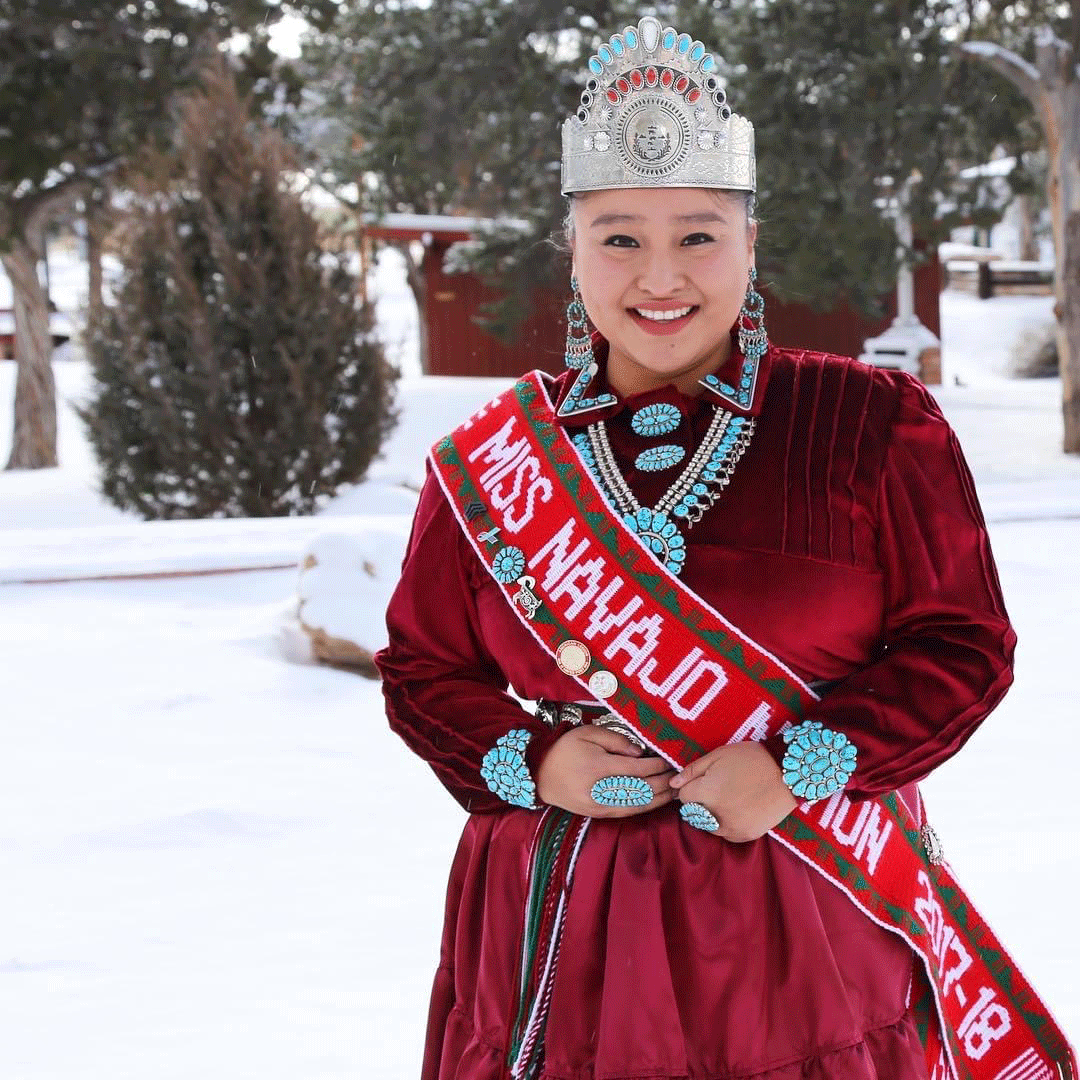
FIG. 4
Crystal Littleben (silversmith and Miss Navajo Nation 2017–2018) wearing a squash-blossom necklace underneath her Miss Navajo sash. Photo courtesy of Crystal Littleben.
Image
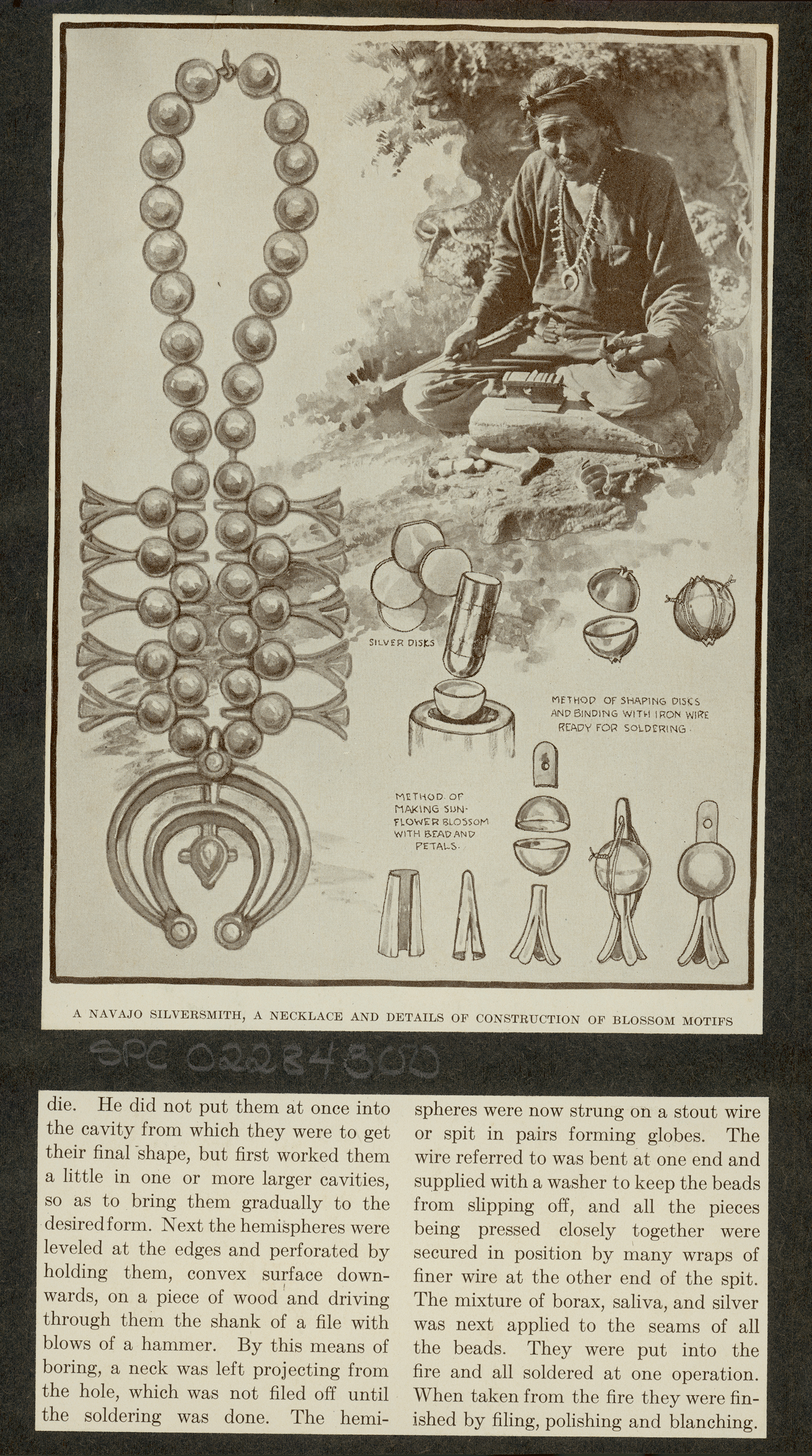
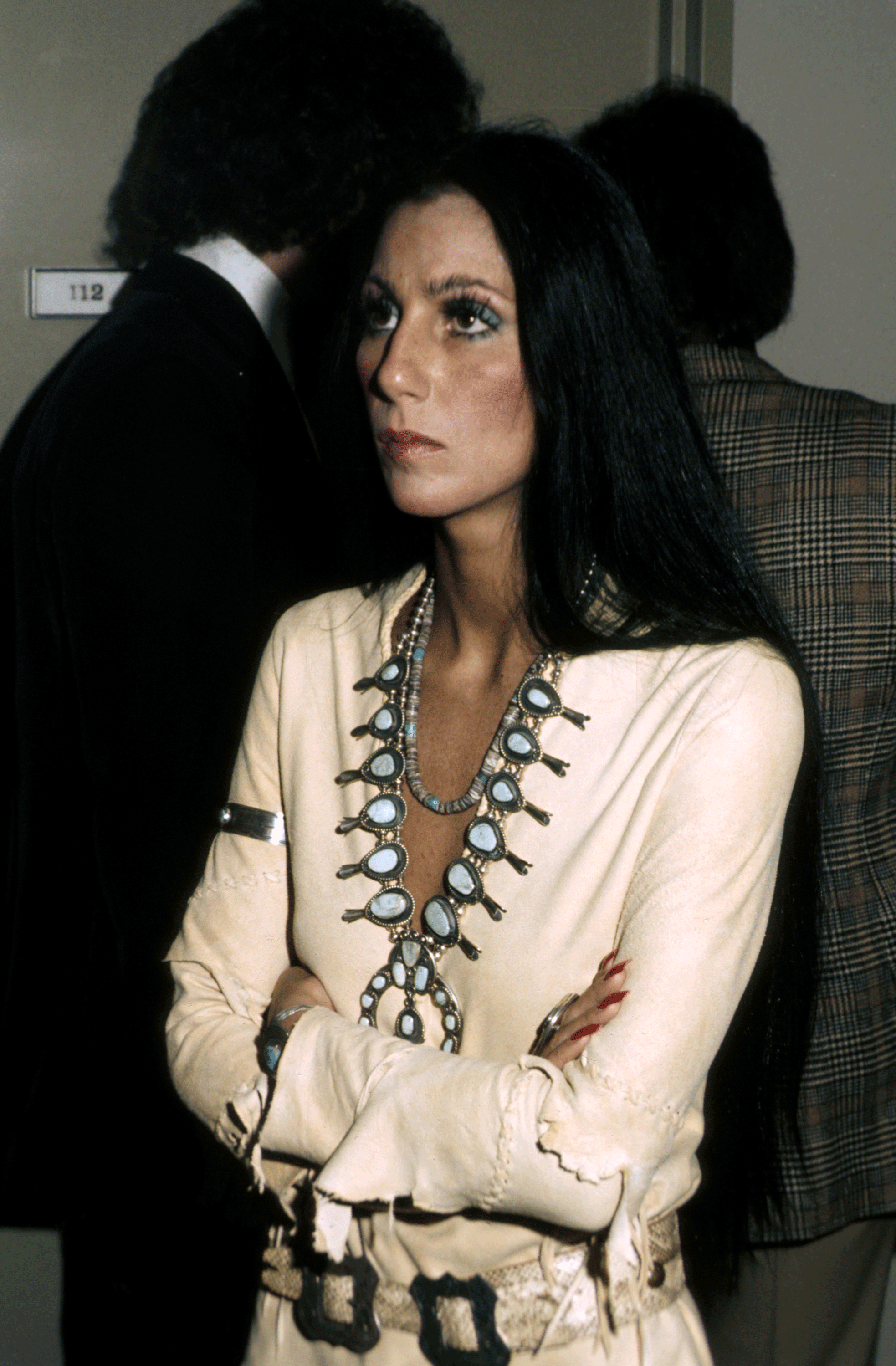
The earliest source of silver for Diné silversmiths were melted American and Mexican silver coins. Eventually, the United States and Mexican governments outlawed melting coinage, prompting trading post owners to import sheet silver into the Navajo Reservation for Diné smiths to use.10 The most recognizable features of squash-blossom necklaces are their silver squash-blossom shaped beads and crescent-moon shaped pendants. For the beads, Diné silversmiths drew inspiration from the blossoms of a squash plant as well as Mexican and Spanish silver clothing ornaments resembling pomegranates, which have a similar shape.11 The Diné word for this bead is yoo’ nímazí disya gi, which translates to “bead which spreads out.” The circular beads were originally made from hammering silver coins into disks, hammering them upward into globes, and then soldering them together to make round beads. Curled sheet silver was then soldered to the bottom of beads to make the squash-blossom form [Fig. 5]. When designing the crescent-moon shaped pendant, Diné metalsmiths drew inspiration from Spanish, Mexican, and Great Plains tribes’ horse bridles with crescent-shaped ornamentation that rested on the horse’s forehead [Fig. 6].12 Some scholars believe that the Spanish adapted the crescent moon-shaped design of the Moors in North Africa, who placed a version of the Islamic Crescent on their horse bridles.13 The Diné word for the pendant is názhah and translates to "crescent shape." Historically, the názhah was made by carving the crescent shape into a piece of tufa stone (a rock made from volcanic ash) and casting the silver into it.14
Squash-blossom necklaces from the “First-Phase” era of Diné jewelry (1868–1900) did not commonly incorporate set turquoise stones, but later necklaces often do.15 Turquoise is a core material in Diné jewelry. Diné elder Wally Brown explains, “Turquoise is just to let the Holy People know when we are addressing them that we understand our origin, which is of course from the second world, before we came into this world. So when we pray to them and we are wearing our turquoise and our silver, they look at us and they say, ‘There is one of our children that knows where they are from and where they are going, what are they asking for; let’s give it to them.’”16 Tribes in the Southwest frequently traded materials like turquoise with each other.
*
The stones in the RISD Museum example could be blue gem turquoise from Nevada or another turquoise mine in the Southwest. This necklace is most likely entirely handmade, created in either an outdoor studio [Fig. 3] or inside a hogan (a traditional Diné home). The maker hammered the spherical silver beads, also called Navajo pearls, from sheet silver. The squash blossom beads in this necklace differ slightly from the original First-Phase squash blossom bead shapes made entirely of silver, instead comprising of a flat piece of silver set with a hand-cut turquoise stone and three blossom petals facing outwards. Originally, Diné smiths chased silver with an awl to create decorative patterns. Eventually, smiths used files and cold chisels for these details.17 During the 1880s, when smiths began creating and utilizing small iron or steel die stamps, creativity in design soared.18 Die stamps have designs filed into one end that is hammered into the work to reproduce the designs.19 Stamp work is central to Diné silverwork and smiths form a myriad of patterns from curvilinear to geometric. Some Diné smiths pass stamps down from generation to generation, creating family designs.20 For this necklace, a triangular stamp with six serrated lines and a liner stamp were used to hammer the designs into the silver [Fig. 7]. The flat silver of the squash blossom bead has a clam design on each side of the turquoise stone. The triangular stamp was used to border the clam form and the liner stamp was used five or six times within the clam shape. Furthermore, the triangle stamp borders the turquoise. The maker strung the stamped squash blossom beads and Navajo pearls together with cotton twine. In the middle of the necklace is a hand-crafted názhah pendant, also made from sheet silver, with two bands of horizontal and vertical set turquoise. The triangular stamp was used on the silver crescent lines above each band of turquoise of the názhah. Finally, a hand-crafted silver j-clasp secures the work to the wearer’s neck.
I think that this piece was made in the 1930s, before World War II. We know that it was made before 1955, because that was the year it was donated to the museum. Additionally, scratches from a hand file are clearly seen on the turquoise stones [Figs. 7 and 8]. After World War II, Diné silversmiths used machinery to evenly polish the stones. Next, the stones are roughly the same size, but still unique in shape. This indicates that they were hand-cut stones and not the commercially calibrated examples Diné silversmiths used later in the twentieth century. The bezels, or silver settings at the base of the stones, look serrated by a handsaw or file. By the late 1950s, most Diné silversmiths were buying commercially made serrated bezels.21 Lastly, the heavy use of turquoise stones is more closely associated with the 1930s than any earlier decade. Unfortunately, there is no stamp or hallmark attributing a maker or makers, which is common for this era of Diné silversmithing. “PUZU” is scratched into the back of the názhah, which is not a typical Diné name but could be the original buyer’s name [Fig. 2].
I imagine that an intricate necklace like this was a showpiece displayed in the window at a trading post on the Navajo Reservation or in a border town near the reservation, enticing tourists to purchase this work and take it back to wherever they called home. In the 1930s, trading-post owners would supply Diné silversmiths with materials such as sheet silver and wire, then buy the jewelry for resale. Individual artists did not make fair profits for their work and were not properly credited within the trading-post system.22 Trading-post owners also suggested design ideas, pressuring Indigenous makers to create works that looked “Indian.” Squash-blossom necklaces in particular became popular tourist souvenirs.23 During this era, many Diné makers sold their work to the trading posts as a means of survival.
Image
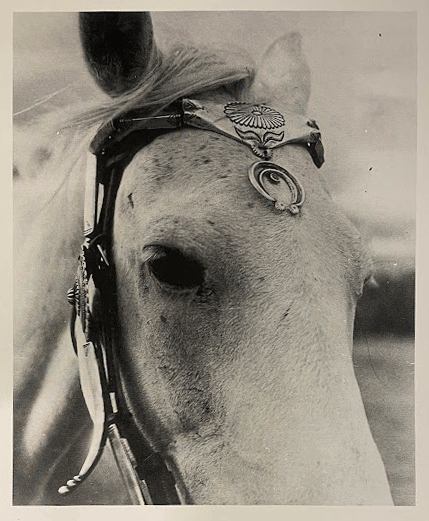
FIG. 6
Silver naja on horse bridle, ca. 1920–1970.
Courtesy of the Palace of the Governors Photo Archives (NMHM/DCA), 038930.
Image
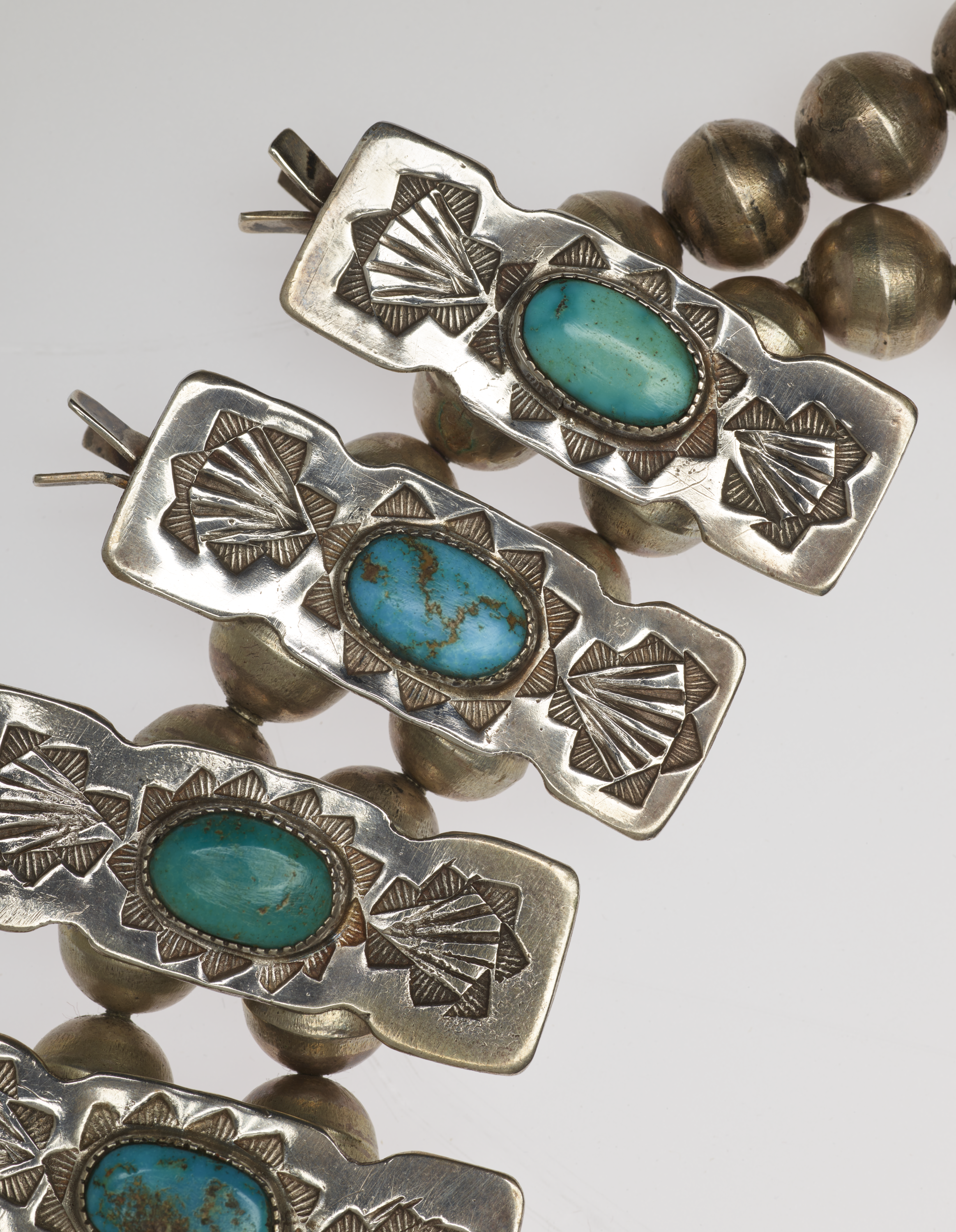
FIG. 7
Diné (Navajo) artist once known
Necklace (details), ca. 1930s
Silver, turquoise, and cotton twine
Anonymous gift 55.050
Image
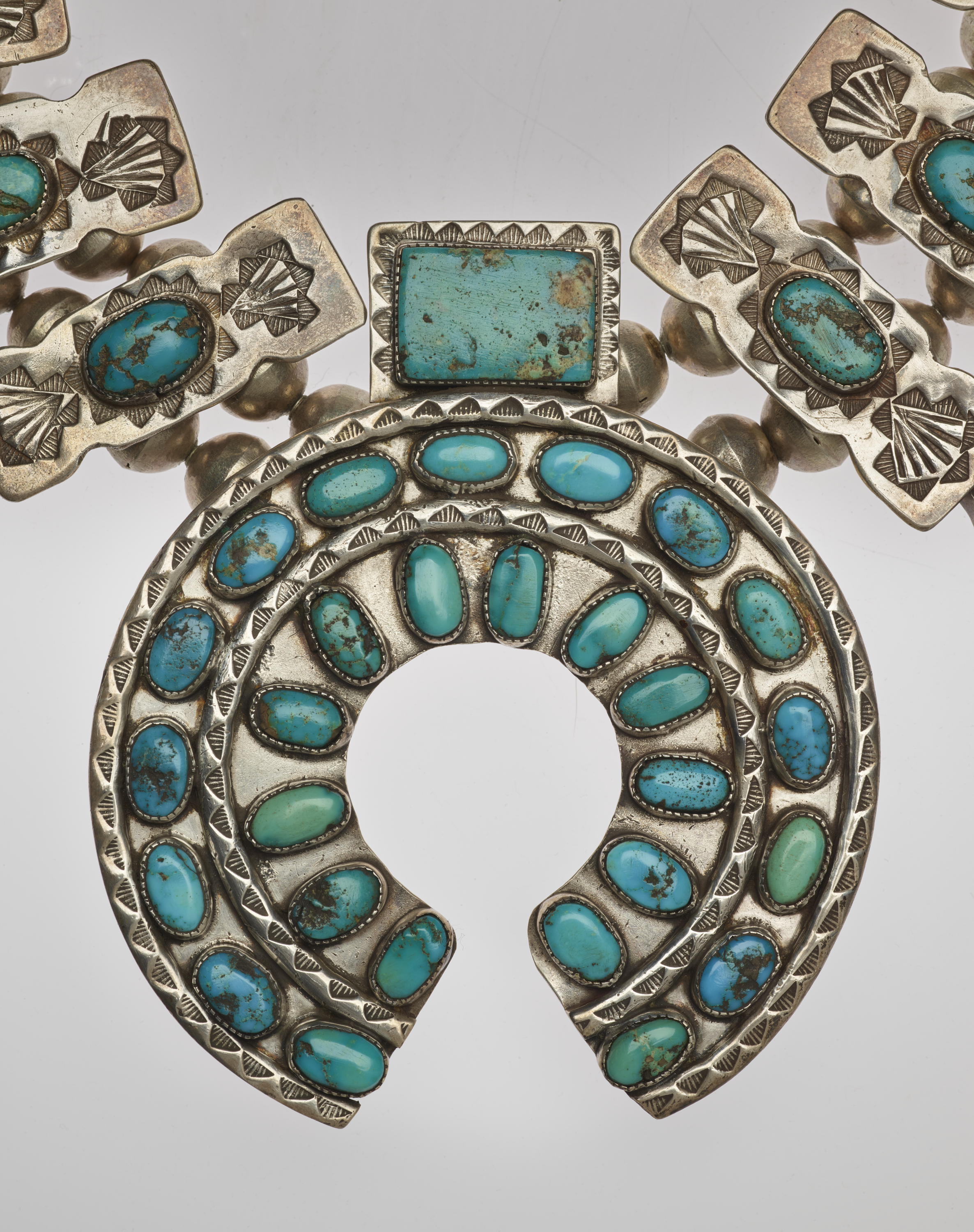
FIG. 8
Diné (Navajo) artist once known
Necklace (details), ca. 1930s
Silver, turquoise, and cotton twine
Anonymous gift 55.050
Image
Image
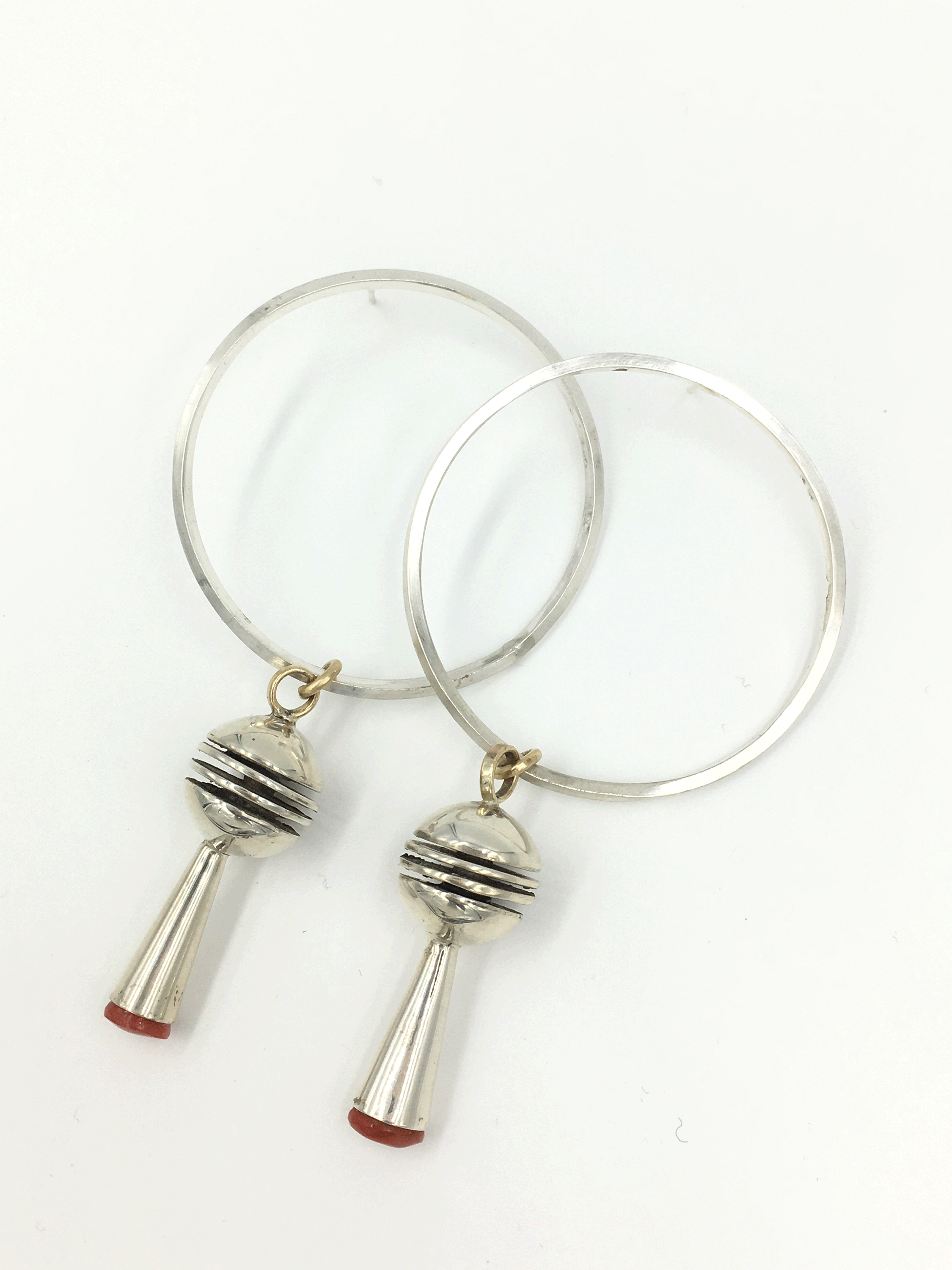
FIG. 10
Nanibaa Beck (Diné), Squash-Blossom Hoops | Rails + Coral,
fabricated sterling silver squash-blossom hoops with coral
and 14k gold accents. Photograph courtesy of Nanibaa Beck.
Image
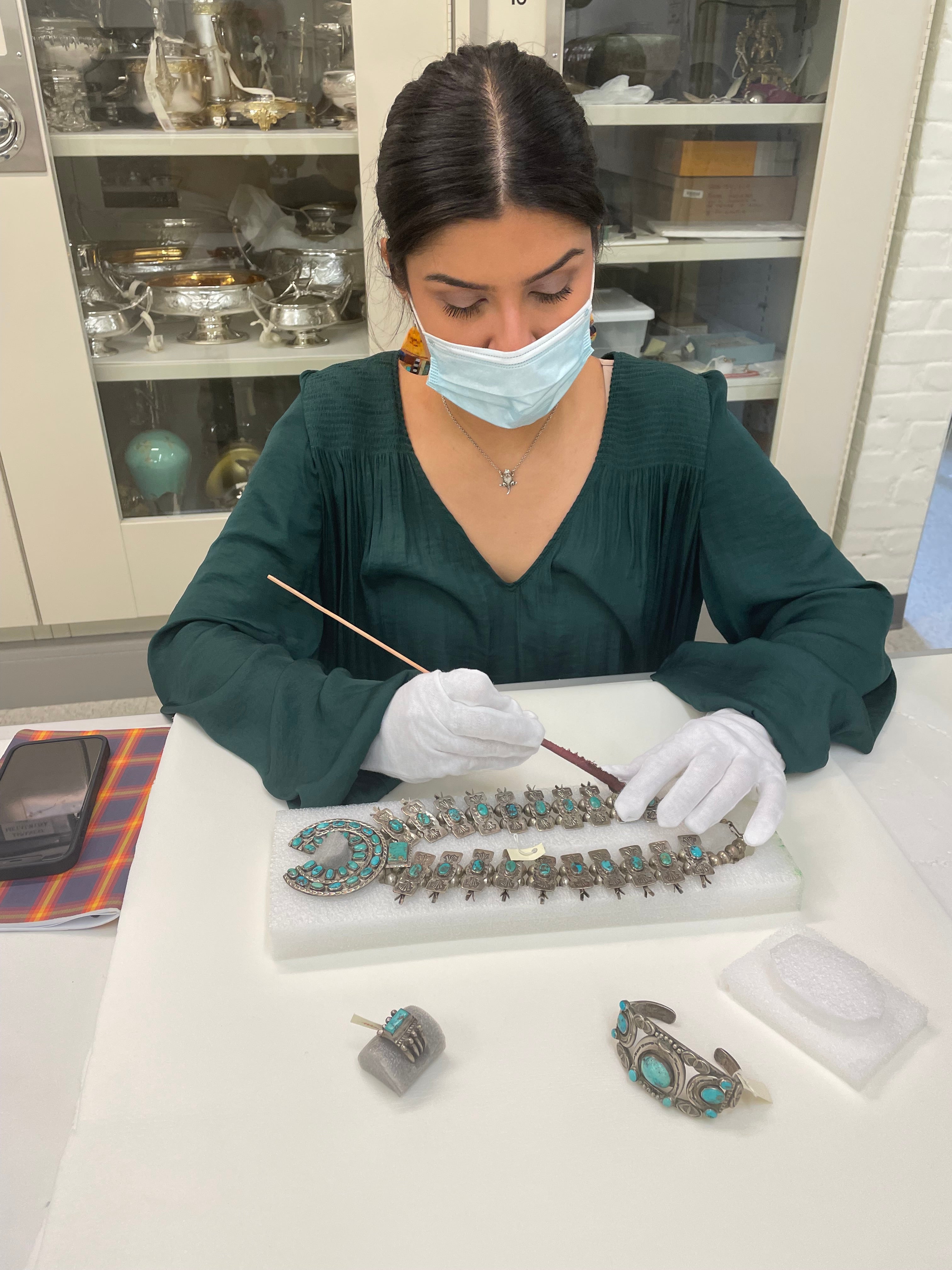
FIG. 11
Author polishing the squash-blossom necklace.
- Diné, our name for ourselves, literally translates to “the People.” Diné is often used interchangeably with Navajo, our tribal government name, given to us by Spanish settlers in the seventeenth century.
- Anthropologist John Adair wrote in 1945, “Because of the conflicting evidence, the origin of silversmithing can not be accurately dated, nor is it likely that it will be in the future.” Adair, The Navajo and Pueblo Silversmiths (Norman: University of Oklahoma Press, 1945), 6.
- The Navajo and Pueblo Silversmiths, 6.
- “The Long Walk,” Native Knowledge 360° Education Initiative, Smithsonian National Museum of the American Indian, https://americanindian.si.edu/nk360/navajo/long-walk/long-walk.cshtml.
- Adair, The Navajo and Pueblo Silversmiths, 9.
- Theodore Brasser, Native American Clothing: An Illustrated History (Buffalo: Firefly Books, 2009), 188.
- James D. Henderson, “Meals by Fred Harvey,” Arizona and the West 8, no. 4 (1966): 305–22. http://www.jstor.org/stable/40167249.
- Lucy Fowler Williams, Water Wind Breath: Southwest Native Art in the Barnes Foundation (New Haven: Yale University Press, 2022), 28.
- Mark Bahti, Silver and Stone: Profiles of American Indian Jewelers (Tucson: Rio Nuevo Publishers, 2007), 12.
- Dexter Cirillo, Southwestern Indian Jewelry (New York: Abbeville Press, 1992), 68.
- Adair, The Navajo and Pueblo Silversmiths, 44.
- Cirillo, Southwestern Indian Jewelry, 73.
- Peter Iverson, Diné: A History of the Navajos (Albuquerque: University of New Mexico Press, 2002), 32.
- There is a tufa stone mold in the RISD Museum collection (Diné [Navajo], Jewelry Mold, late 1800s, Gift of Dr. Otto Kallir 42.287). A butterfly design was carved into the stone and the mold could have been used to make a silver pin, ring, or cuff.
- Cirillo, Southwestern Indian Jewelry, 79.
- “Four Worlds and the Importance of Silver and Turquoise,” https://www.youtube.com/watch?v=WiyKXlEWoOQ.
- Adair, The Navajo and Pueblo Silversmiths, 37.
- Adair, The Navajo and Pueblo Silversmiths, 31.
- Adair, The Navajo and Pueblo Silversmiths, 24.
- “Stamping,” Garland’s Blog, https://www.shopgarlands.com/blogs/news/70546755-stamping.
- Special thanks to Shane R. Hendren (Diné) and Jeff Georgantes for their silversmithing insights on the technical aspects of this necklace.
- Peter Iverson, Diné: A History of the Navajos (Albuquerque: University of New Mexico Press, 2002), 79.
- Williams, Water Wind Breath, 29.
- Andrew Curley, “T’áá hwó ají t’éego and the Moral Economy of Navajo Coal Workers,” Annals of the American Association of Geographers 109, no. 1 (2019), 71–86, https://doi.org/10.1080/24694452.2018.1488576.
- Nancy Marie Mithlo, “No Word for Art in Our Language? Old Questions, New Paradigms,” Wicazo Sa Review 27, no. 1 (2012): 111–26, https://doi.org/10.5749/wicazosareview.27.1.0111.
- “Census: Navajo enrollment tops 300,000,” Navajo Times, July 7, 2011, https://navajotimes.com/news/2011/0711/070711census.php.
- “Significant [sic] Behind Navajo Traditional Clothing,” https://www.youtube.com/watch?v=h_A3HmegYJ0&t=439s.
- Adair, The Navajo and Pueblo Silversmiths, 44 n. 12.
- Williams, Water Wind Breath, 146.
Cite this article as
Chicago Style
MLA Style
Shareable Link
Copy this page's URL to your clipboard.