Crystal (Changfeng) Wang
MA Design Engineering
ResuMance
Our board game aim to help new grads prepare for interviews and resume building. The goal is to address a common gap: most new grads don’t get enough practice with mapping out their strength and resources strategically, which could decrease their competitiveness in the career environment, and may lower their confidence. The game uses the methodology approach such as role-playing and simulated environments to mirror real-world scenarios that allows players to practice through repetition and build confidence through experience, and filling up the gap of limited access to the professional career advisors.
Project done in collaboration with Shuyi Mao MA 26 DE and Liuyiwei (Liu) Hu MA 26 DE.
Image
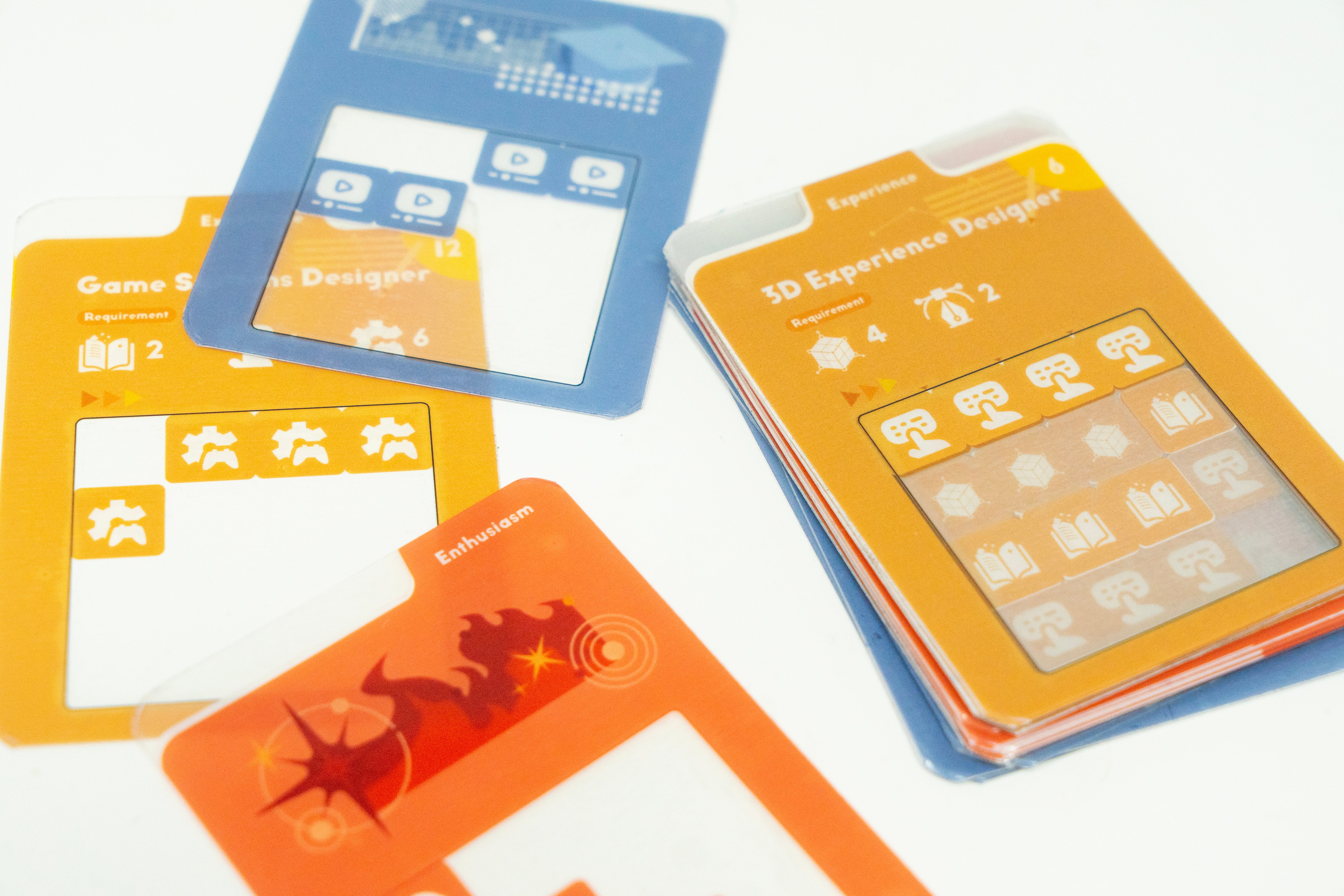
ResuMance - Board Game Prototype
Interactive tabletop prototype exploring persuasive communication and resume-building through role-play and strategic storytelling. Players arrange transparent experience cards over job-description cards to simulate how qualifications are interpreted in real-world hiring scenarios. The layered acrylic system reflects how experience can be reframed, combined, and presented differently depending on context. Featured cards include roles such as “3D Experience Designer” and “Game Systems Designer,” alongside attribute cards like “Enthusiasm.” Materials include printed cards, transparent acrylic overlays, and modular icon-based components. Prototype dimensions vary by card type. Photo documentation of physical gameplay system and interaction mechanics.
Image
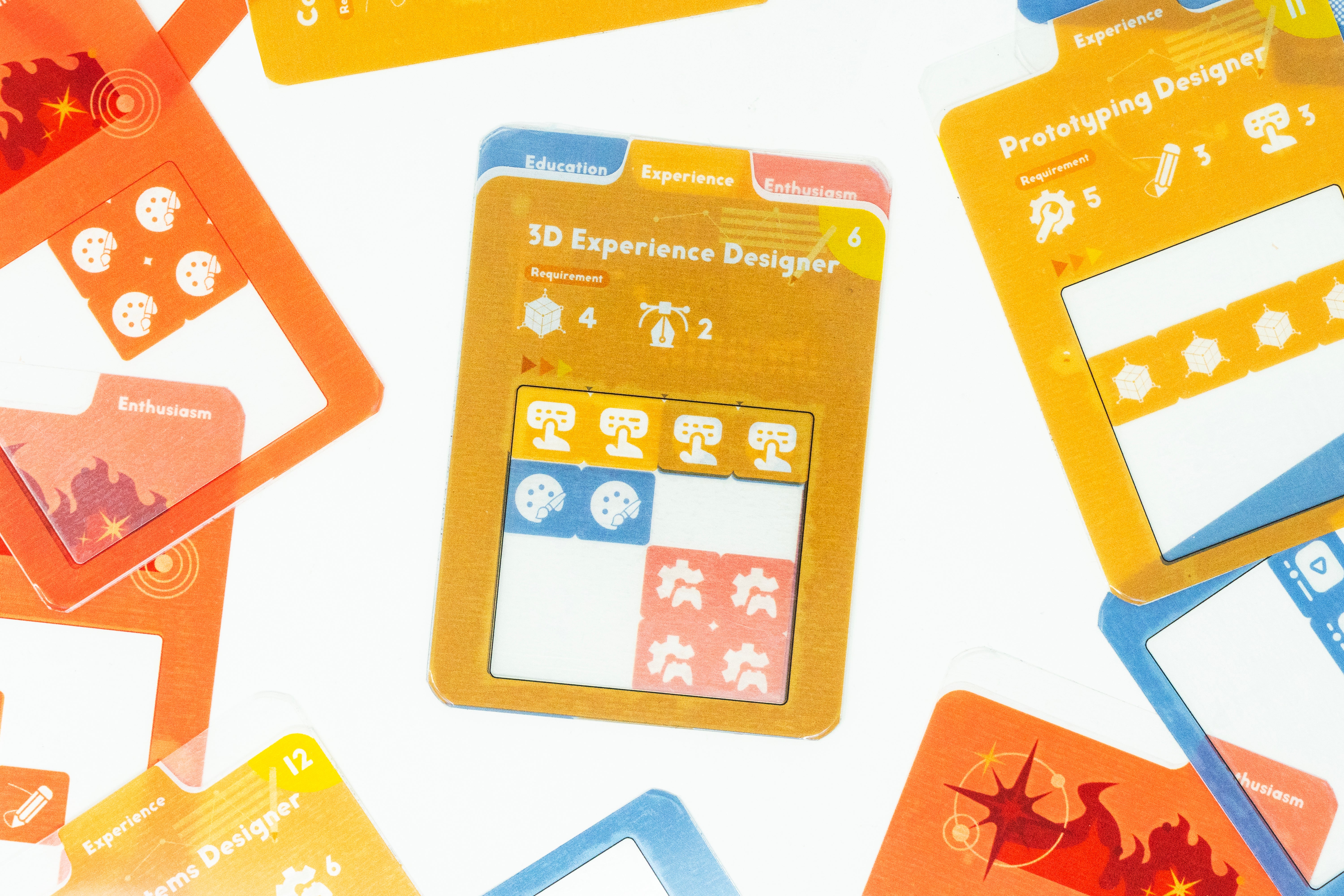
ResuMance Gameplay Interaction System
Close-up documentation of the ResuMance board game interaction mechanics. Players use transparent overlay frames and modular experience tiles to construct narratives that match the requirements of different job cards, such as “3D Experience Designer” and “Prototyping Designer.” The system transforms resume-building into a strategic storytelling exercise, where qualifications are intentionally rearranged and interpreted within limited spatial constraints. Color-coded categories including education, experience, and enthusiasm visually represent different aspects of professional identity. Materials include printed cards, acrylic overlays, and modular icon-based components designed for tabletop gameplay and collaborative role-play. Photo documentation of physical prototype and gameplay arrangement.
Image
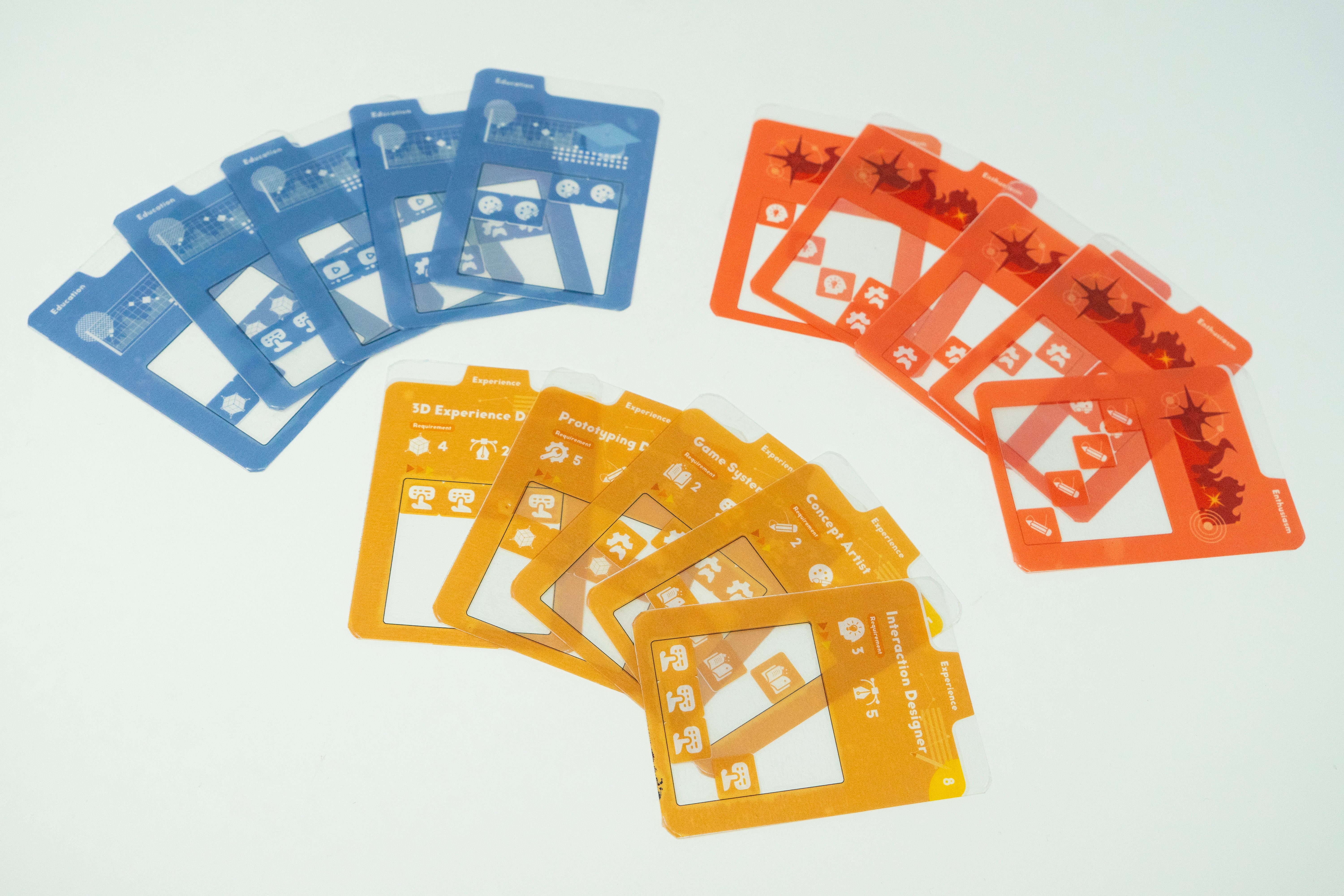
ResuMance Card System Collection
Overview of the ResuMance physical card system, featuring role cards, transparent overlay frames, and category-based experience components. The prototype includes career paths such as “3D Experience Designer,” “Interaction Designer,” and “Concept Artist,” alongside modular overlays representing education, enthusiasm, and experience. Players combine and layer these elements to construct persuasive narratives under spatial and strategic constraints, simulating the ambiguity of real-world resume interpretation and hiring conversations. The transparent acrylic overlays allow qualifications to be reframed and reorganized dynamically during gameplay. Materials include printed cards, acrylic transparent frames, and icon-based modular pieces designed for collaborative tabletop interaction and role-play. Photo documentation of the complete prototype system and visual language.
Image
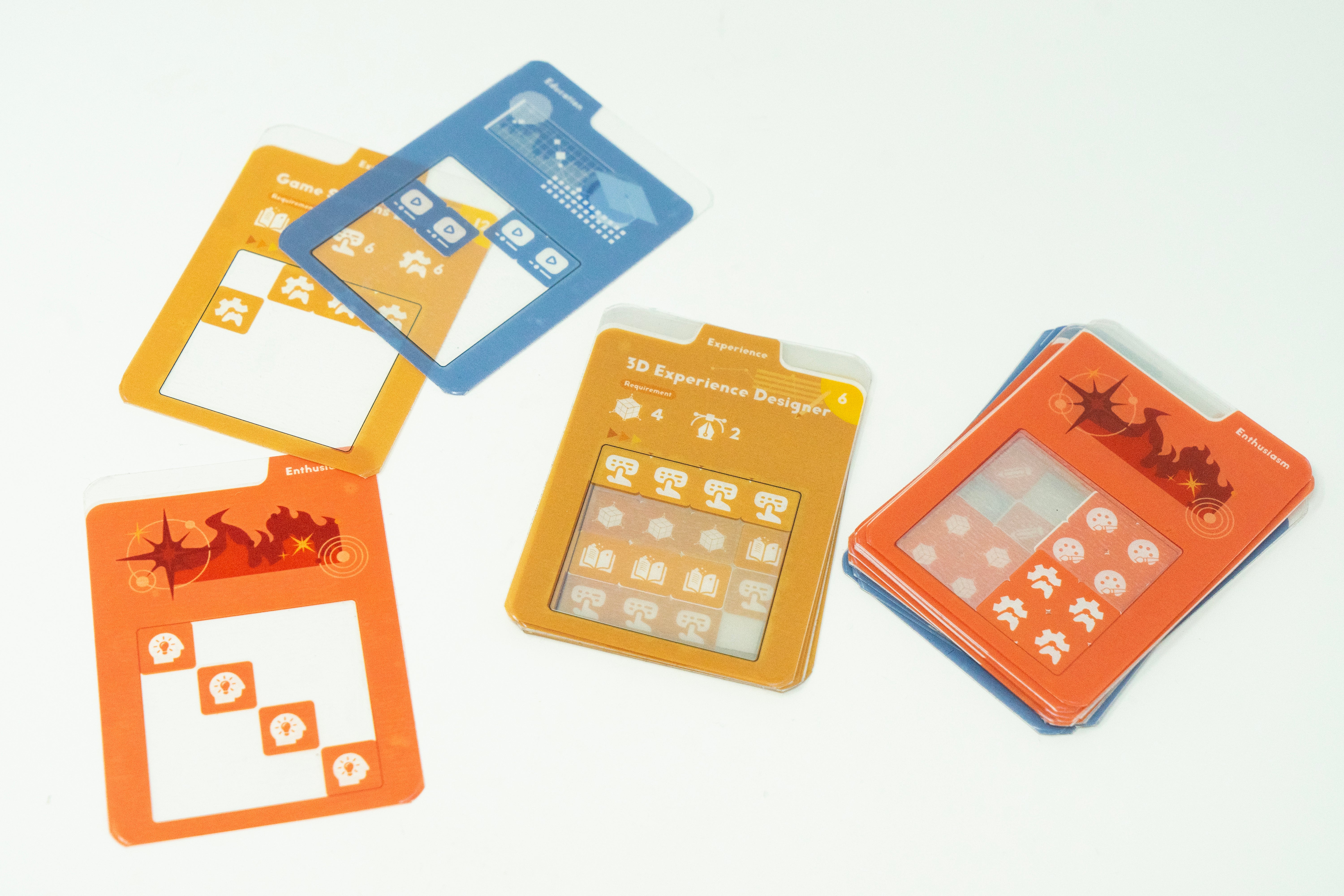
ResuMance Transparent Overlay Components
Detailed view of the transparent overlay component system used in the ResuMance board game prototype. The acrylic frames function as interactive filters that allow players to selectively reveal, reorganize, and frame qualifications across different career-role cards. By layering experience, education, and enthusiasm components onto job descriptions, players simulate the strategic storytelling and interpretation involved in real-world interviews and resume evaluations. The transparent structure emphasizes how professional identity is constructed through context, positioning, and communication rather than fixed qualifications alone. Materials include laser-cut transparent acrylic overlays, printed role cards, and modular icon-based gameplay elements designed for collaborative tabletop interaction and role-play exercises.
Image

Rhode Island School of Design
20 Washington Place
Providence, RI 02913–2784
United States of America
+1 401 454 6100
+1 800 364 RISD
QUICK LINKS
risd.edu
Graduate Studies


Image
Rhode Island School of Design
20 Washington Place
Providence, RI 02913–2784
United States of America
+1 401 454 6100
+1 800 364 RISD