Deborah Khodanovich
MFA Graphic Design
Just Between Us (and everyone we tell...)
Graphic designers are often obsessed with their publics. The desire to be seen, to be heard, to have our work reach the broadest audience possible—these are goals deeply ingrained in the discipline. But why? This thesis challenges us to abandon this fixation, proposing instead that graphic design should concern itself with the private—the intimate, the local, the unseen.
This is where gossip comes in. Gossip is the language of the invisible, a form of sharing, knowledge-production, and preservation that has historically been dismissed as frivolous, immoral, and—most egregious of all—associated with women. Gossip networks offer a model of connectivity, of relationality. Before the internet, before mass media, before centralized knowledge institutions, gossip was how people understood the world around them. It was how we knew what plants were safe to eat, who could be trusted, what dangers lurked in the shadows. It was how marginalized people, in particular, shared wisdom, organized, and built networks of care.
My work has always been defined by the understanding that everything that I am exists in relation to others. It takes an audience to activate an artwork, it takes a community to activate its own values, it takes many, many people working collaboratively to create new knowledge. When we think of knowledge production in academic spaces we often think about scientifically researched methods with peer reviews by other qualified professors and researchers. But gossip is knowledge that is created from the co-authorship of feminized spaces, ‘peer reviewed’ by those in our communities, passed down information, critical thinking as a group space, a form of knowledge production absent from the rules and dictations of capitalism. This is what this body of work aims to understand: How do we create space for the more informal methods of knowledge production, and how do we use gossip as a methodology for that making?
Video file
Gossip: An Investigation into the Feminine Art of Conversation
Handbound book with letterpressed endpapers
10 x 16"
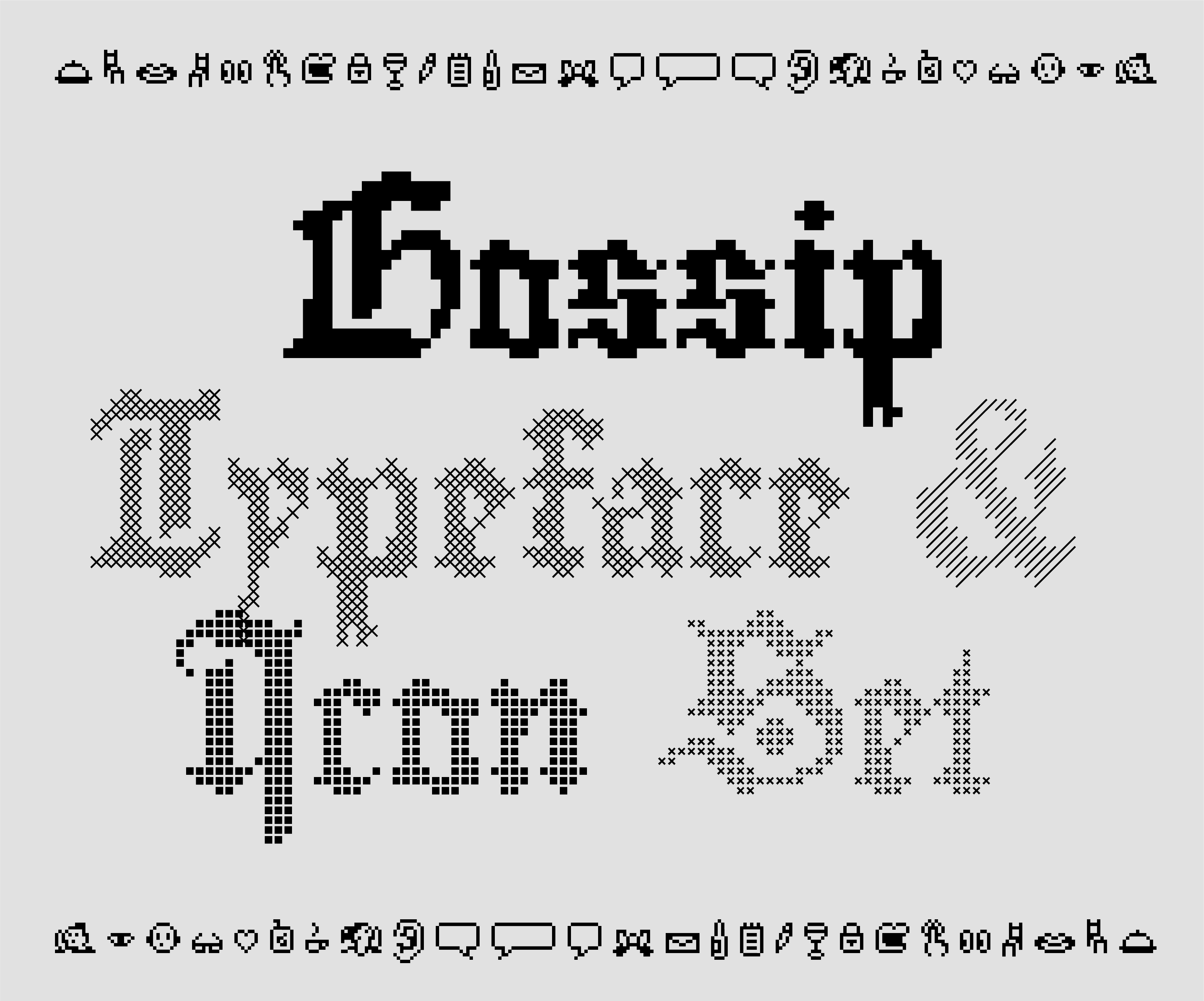
This artist’s book explores the relationship between gossip and textiles through an image archive, a pixel font inspired by Gutenberg's first font Textura, and an icon set inspired by Susan Kare's pixel designs for the initial web.
My interest in the relationship between the two arose from the many crafternoons I’ve held with my friends. A space we gathered to knit, embroider, create together, filled with hours of gabbing and laughing and dissecting all of our relational experiences. The hypothesis grew that this wasn’t unique to us, but that women have historically used these craft spaces as a means of information sharing and resistance to power. It is how the craft of gossip and its use, historically associated with women, has been used to create and sustain social networks for centuries.
The book is split into 3 sections. The first is an image archive originally collected on are.na, from library and museum archives of people gossiping and gathering in communal spaces to knit, weave, and craft. The second section acts as a type specimen for the Gossip font, displaying all of the weights, sizes, and styles. The final section translates the typography back into textile patterns, including a workbook of space for folks to contribute their own designs. The book as a package, becomes a radical reclamation of leisure and connection.
Image
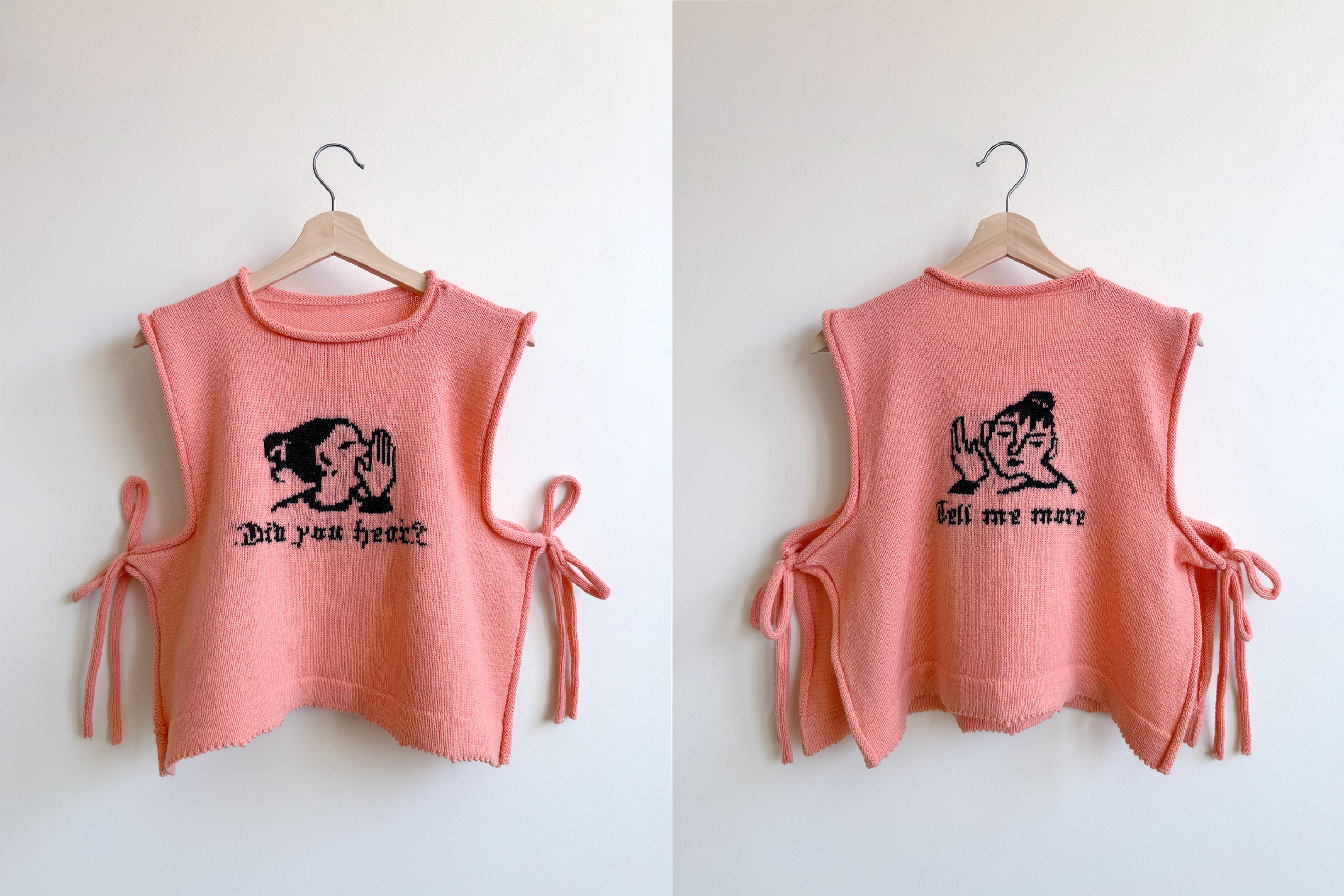
Part of the larger Gossip project, these textiles were machine-knitted using both punchcards and by hacking the machine for manual fair-isle techniques. The double sided vest shows the icon and font set in-use in multiple sizes. All was knit in locally sourced wool and with self-drafted patterns.
Image
Image
Relational Citation Style
Co-authorship as a method of relational practices became the forefront of a lot of the work and thinking I continued to make. Naturally then the question of attribution began to come up, in part because I was attempting to keep track of all my conversations to properly cite those who helped in any way along my process, and in part because of my perception that all I make has never been made by only me. We are constantly recycling, reproducing, remixing ideas, and personally claiming any one thing as entirely my own has always felt icky to me.
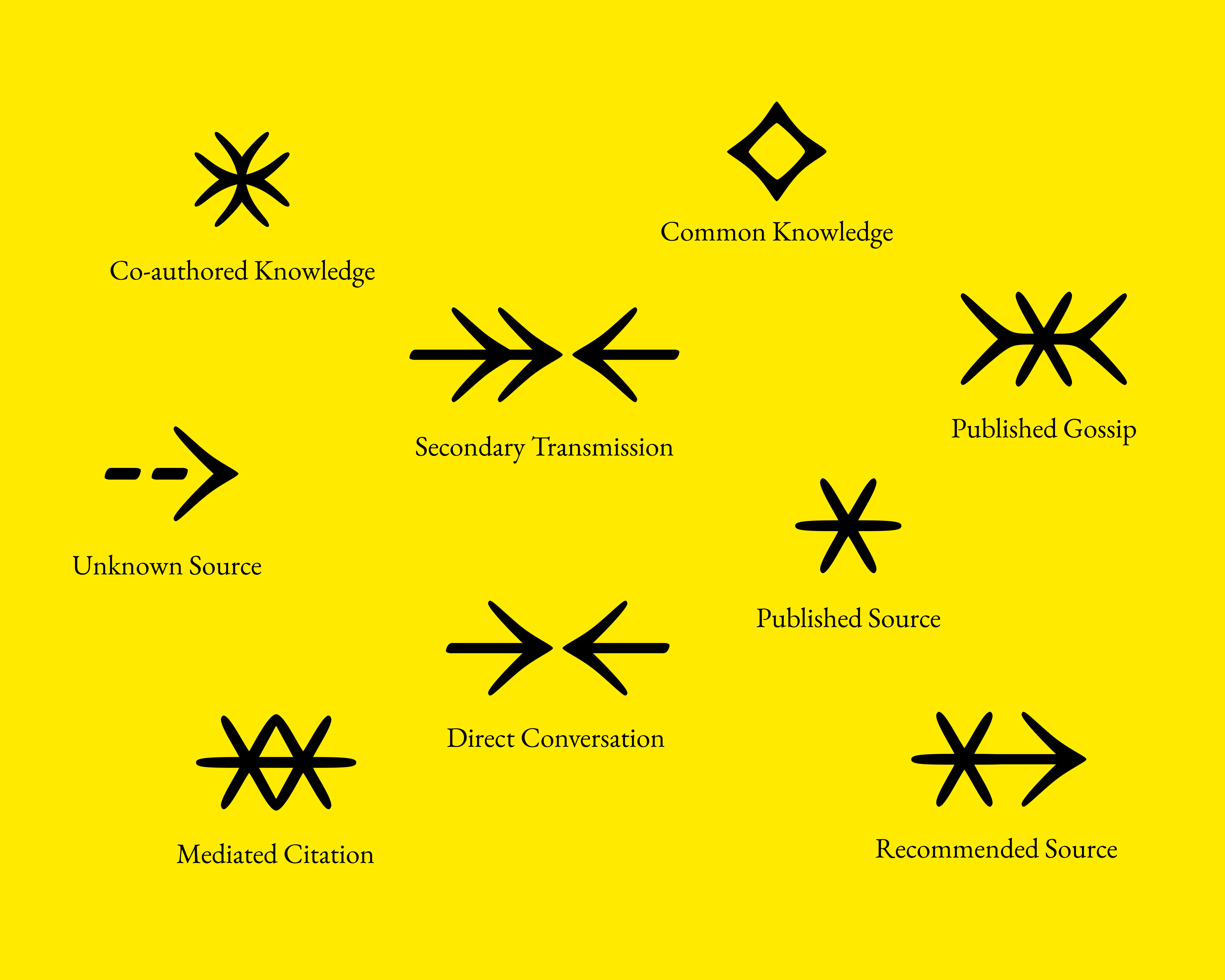
Relational Citation Style was a system that grew out of exactly that — many many dialogues and people who I crossed paths with. I took an open-source academic font, EB Garamond, and developed custom glyphs to act as symbolic notation to go along with superscript in footnotes. The glyphs introduce other forms of knowledge that can be cited alongside published & copyrighted sources, to legitimize them within existing systems. It learns from both feminist and indigenous citation practices, with an emphasis on generosity and care, and the importance of tracing lineage. RCS treats oral transmission and collaborative thinking as legitimate and valuable scholarly sources that should be properly credited and traced along its lineage.
Video file
The Relational Citation Style Handbook
Letterpressed covers, interiors on Omnilux Opaque Digital 20lb paper, saddle stitched.
3.75 x 6"
The Relational Citation Style Handbook is a small academic book made for librarians and scholarly spaces to distribute for use in the aid of using the system. Like any other citation manual, it dictates all the rules and agreements on how to use the style properly, and how to understand the differences between in-text citations, footnotes, and the sources cited at the end of a research paper.
Image
How to Cite your Friends
Offset printed, 50lb white newsprint, at Linco Printing in New York.
11.25 x 16.5”
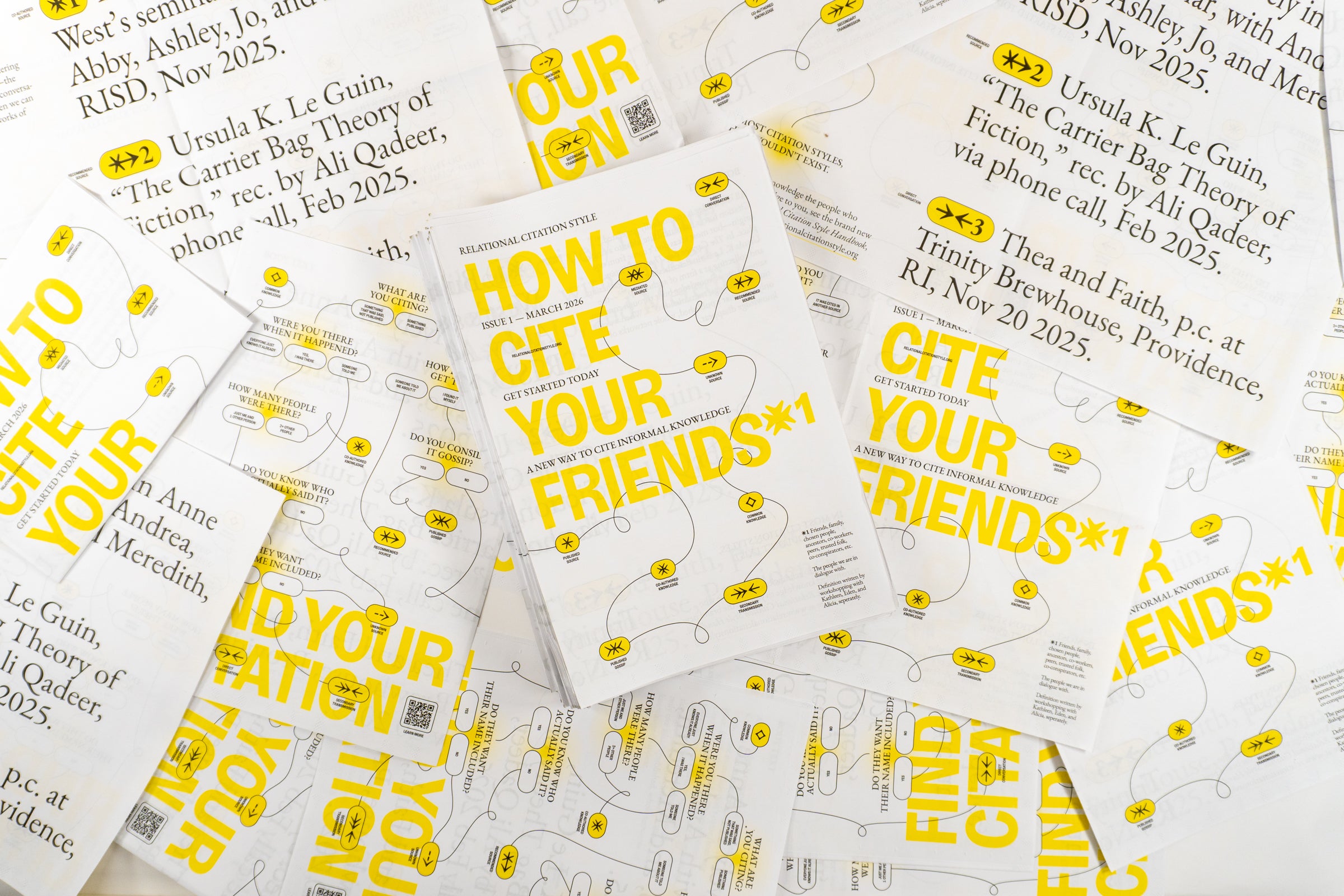
How to Cite your Friends is a 4 page broadsheet that calls the public in on understanding the need of this new citation system. The poster formed as a newspaper is exciting and bold, showing how the system works through flipping the hierarchies of the body text and the footnote. The back of the paper borrows from teen magazines, including a fun quiz that can be taken to help someone get started with understanding the different types of citations.
Image
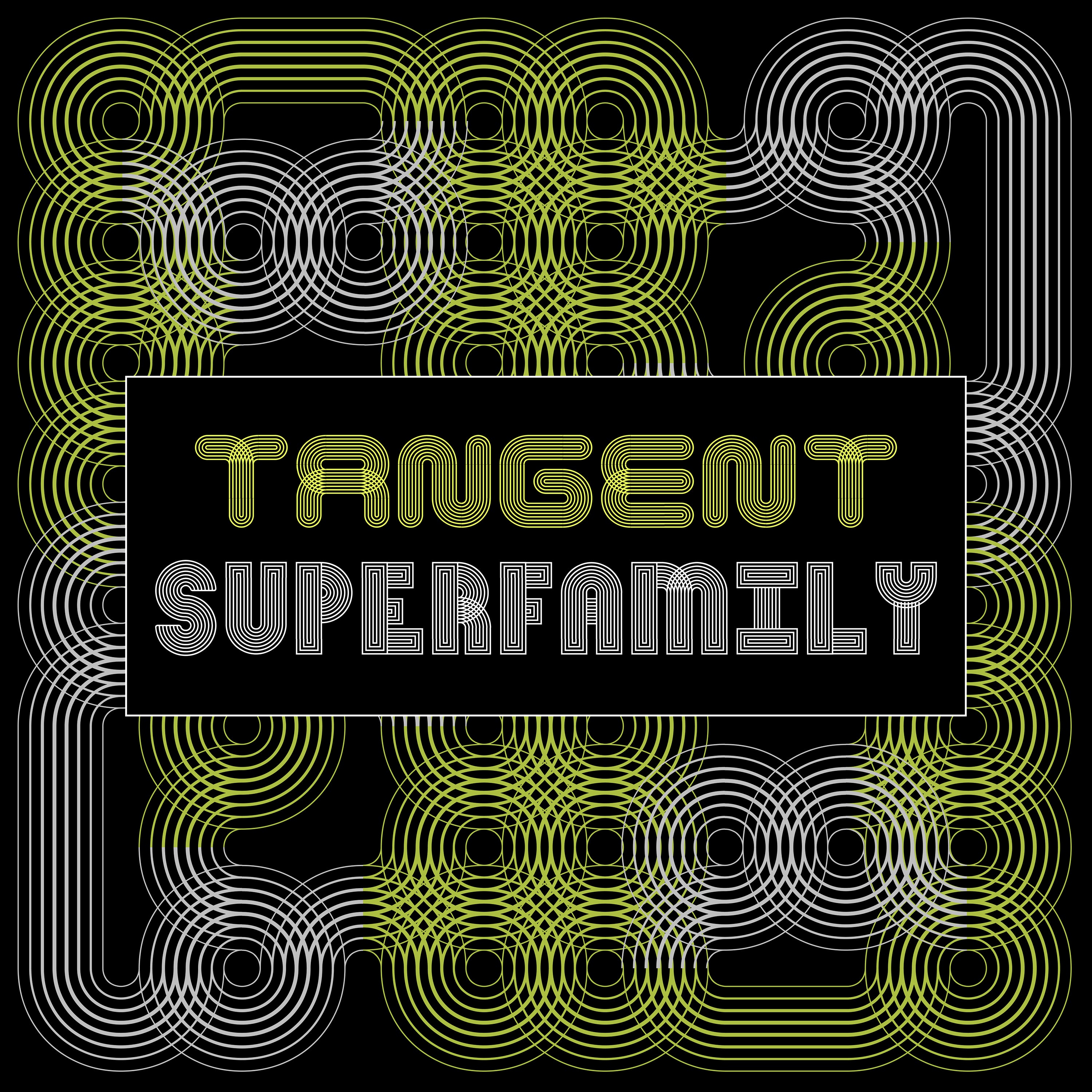
Tangent Superfamily
Collaboration with Saachi Mehta MFA 26 GD
Tangent is a generative variable type system with three constructions—Mono, Sans, and Form. Each style contains 4 axis (radius, twist, weight, amplitude), with an additional axis of stretch in the sans style. The concept for the system starting from the overlap of our thesis inquiries, how does gossip and oral story-telling transform and shape shift? How do stories get twisted? What paths and lineage do these conversations evolve through?
Completely collaboratively we designed a system of glyphs that are always connected to one another. A series of corners, edges, terminals, and so on, that could then function as a generative system for type and form making. Rather than fixed forms, Tangent treats typography as a dynamic system where meaning emerges through continuous generation and exchange.
Video file
gossip is fun; gossip is safety; gossip is an exchange of information to better understand the social dynamics in groups; gossip is sharing stories about ourselves; gossip is currency; gossip is caring for those in our communities.
psssst.xyz is a website that highlights the gestures of gossip. Stemming from the idea of the semi-colon, we can understand gossip to be a never ending string of ideas. The landing page introduces a definition of gossip, and then is preceded by a series of gestures that help us visualize what gossip can look like. Built primarily from community contributions, we see how gossiping is just what it means to be human.
Image

Rhode Island School of Design
20 Washington Place
Providence, RI 02913–2784
United States of America
+1 401 454 6100
+1 800 364 RISD
QUICK LINKS
risd.edu
Graduate Studies


Image
Rhode Island School of Design
20 Washington Place
Providence, RI 02913–2784
United States of America
+1 401 454 6100
+1 800 364 RISD