Harin Kim
Mdes Interior Architecture
The Marathon without Running: Experiencing a runner’s sensorial journey
The marathon is defined not only by motion, but by the changing bodily conditions that unfold over time. Breath, cadence, heat, sound, crowd density, and attention shift throughout the race, producing internal phases that shape the runner’s experience. Yet these states remain difficult for spectators to access from the sidelines.
This thesis asks how exhibition design can translate a runner’s physical sensations and emotions into a multidimensional experience for spectators who do not run. Through a sequence of temporary pop-up exhibitions placed along the New York City Marathon route, the project stages three key emotional and physiological moments: adrenaline, exhaustion, and fortitude. Each site is selected in relation to both the actual route and the runner’s changing condition during the race.
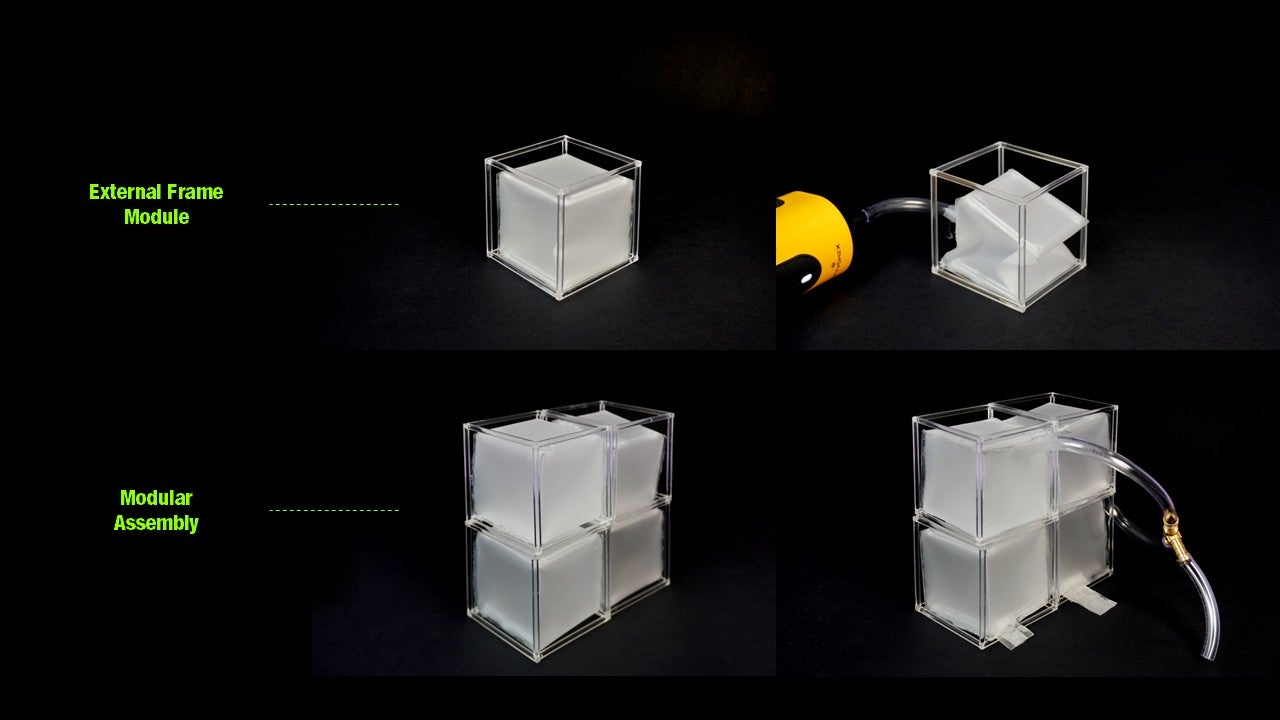
Designed to exist only on marathon day, these installations transform spectatorship from passive viewing into durational, embodied participation. As runners continue forward and spectators pause, the exhibitions align moving and stationary bodies through sensory translation. Pneumatic structures register breath and physical strain through movement, while temperature variations evoke accumulated bodily heat. Layered sound and restrained visual information further shift spatial orientation, allowing spectators to encounter the marathon through bodily sensation rather than observation alone.
By translating the runner’s shifting condition into spatial, tactile, thermal, and sonic experiences, this thesis expands the marathon beyond a race reserved for runners. It allows spectators gathered along the route to enter the physical and emotional atmosphere of the event through their own bodies. In this way, exhibition design becomes a method for translating one bodily experience into another, making it possible to experience the marathon without running.
Image
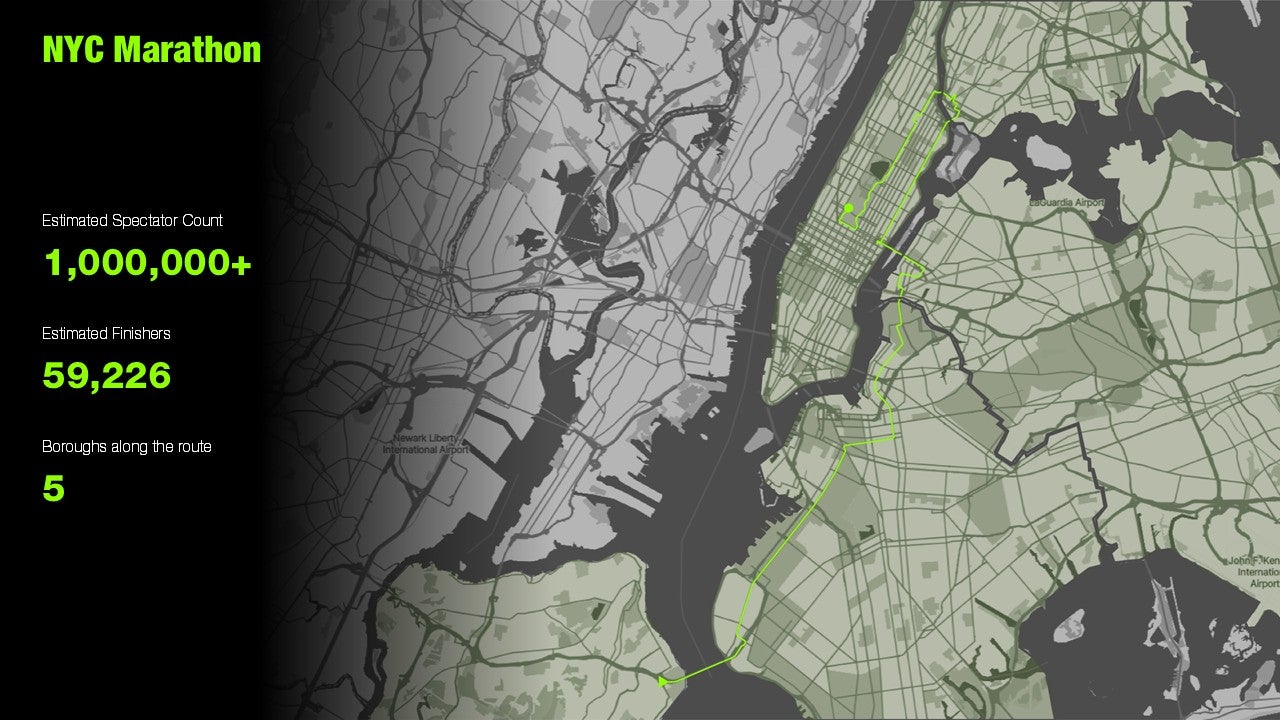
The NYC Marathon operates not only as a race, but as a city-scale public event. Across five boroughs, runners, spectators, volunteers, families, and residents temporarily share the route. While runners move continuously, spectators participate through a different rhythm: waiting, tracking, cheering, and relocating along the course.
Image
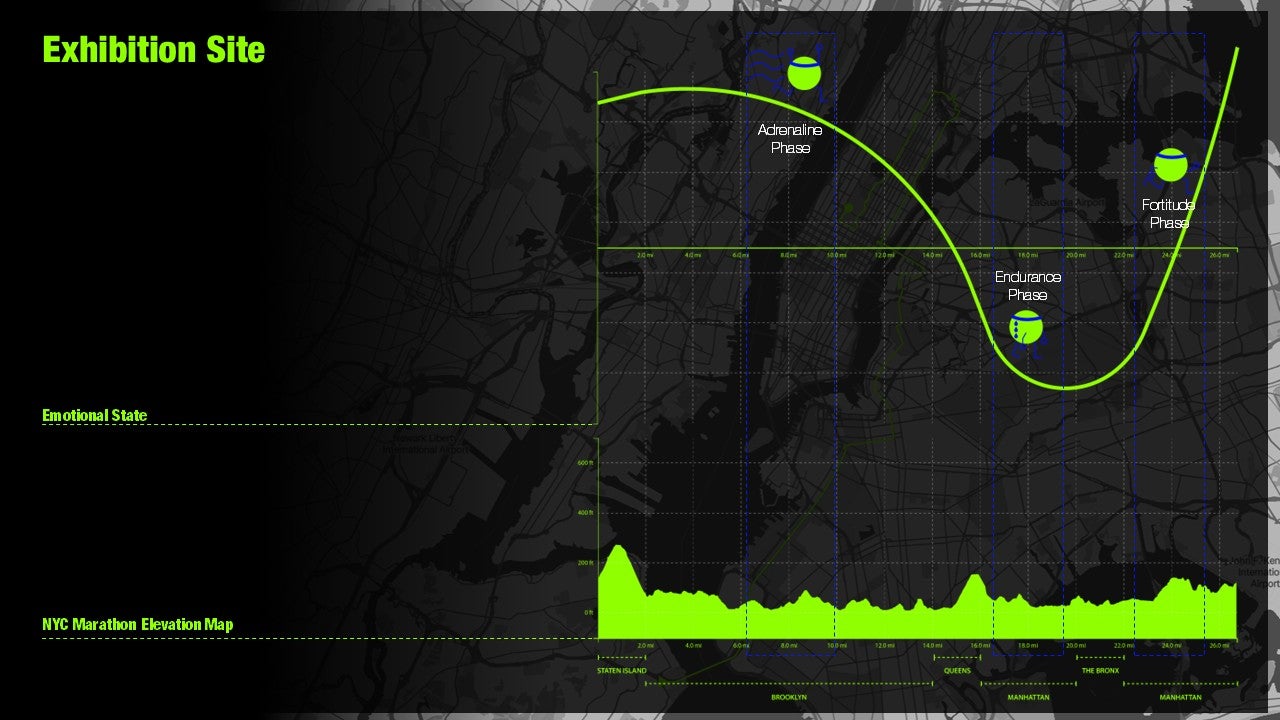
The project is structured across three sites along the New York City Marathon route. Each site is situated according to both the spatial logic of the course and the evolving emotional and bodily conditions of the runner. The first site is located at mile 8, where adrenaline is still high, and the rhythm of the race feels sustainable. The second is located at mile 18, where accumulated fatigue intensifies, and runners often encounter a psychological and physical threshold. The third is located at mile 24, where the proximity of the finish line introduces a final moment of transition and release.
Image
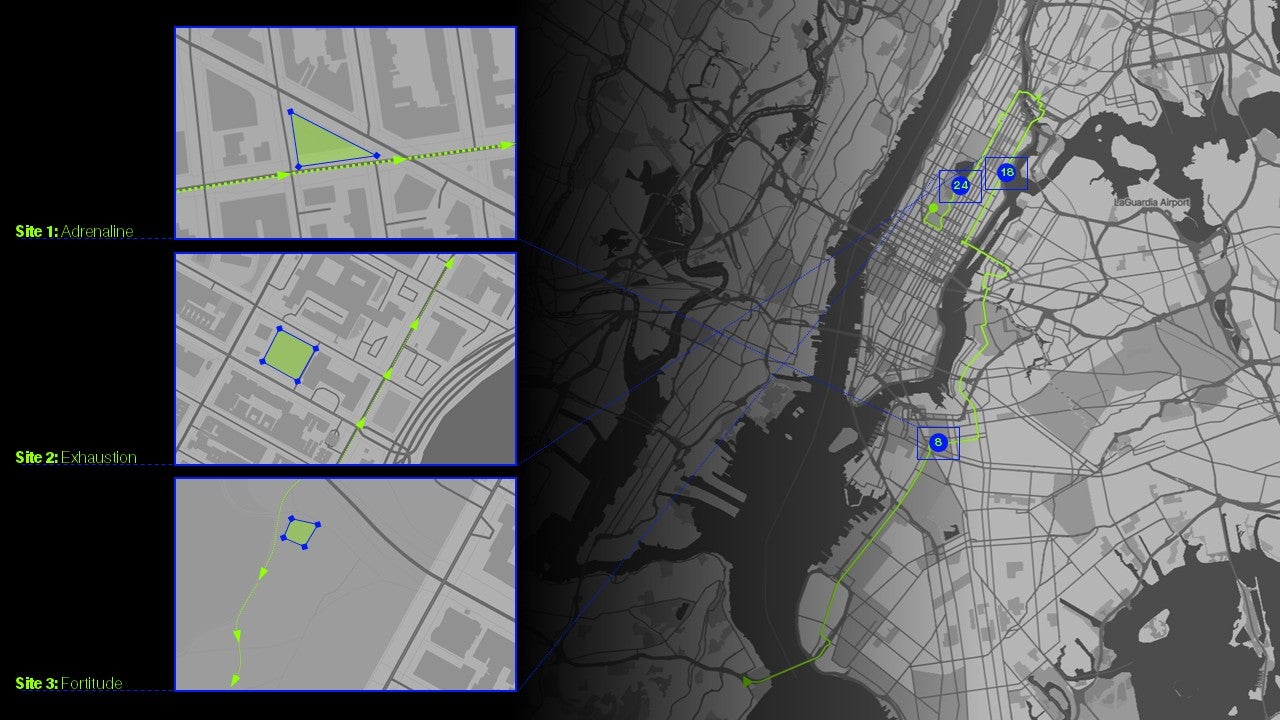
Site 1: Mile 8 — Adrenaline
A park directly adjacent to the route, where runner waves begin to converge and early exertion starts to accumulate.
Site 2: Mile 18 — Exhaustion
A strong cheering point before the Bronx, accessible from Mile 8 by the Q line, where focus narrows and support becomes critical.
Site 3: Mile 24 — Fortitude
A final support point near the finish, where runners push through the last intense effort and cheering becomes especially powerful.
Image
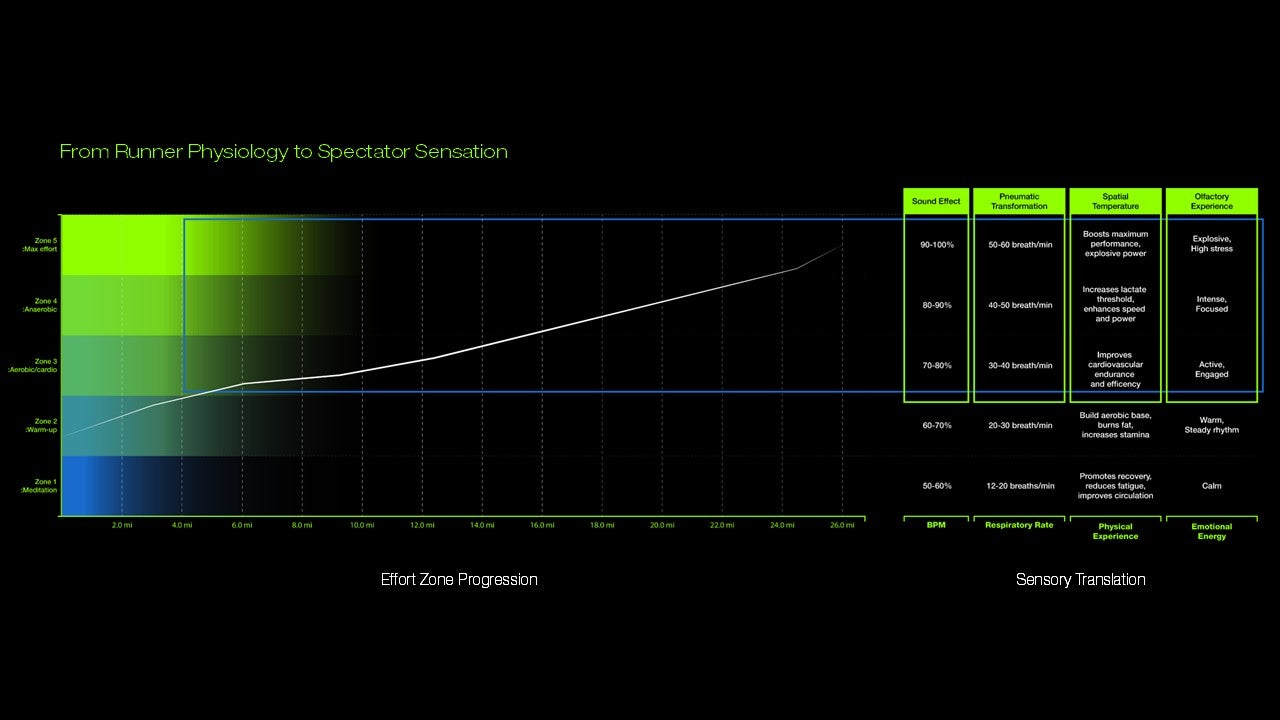
This diagram explains how the runner’s physical changes during a marathon are translated into spatial sensory elements. Since runners typically move through Zones 3 to 5 during the race, this framework breaks down the runner’s condition into three categories: BPM, respiratory rate, and physical zone.
Each category is translated into a spatial sensory language. BPM becomes sound, the respiratory rate becomes pneumatic contraction, and the physical zone becomes color. Through this framework, the runner’s internal condition becomes a set of spatial cues that spectators can encounter physically.
Image
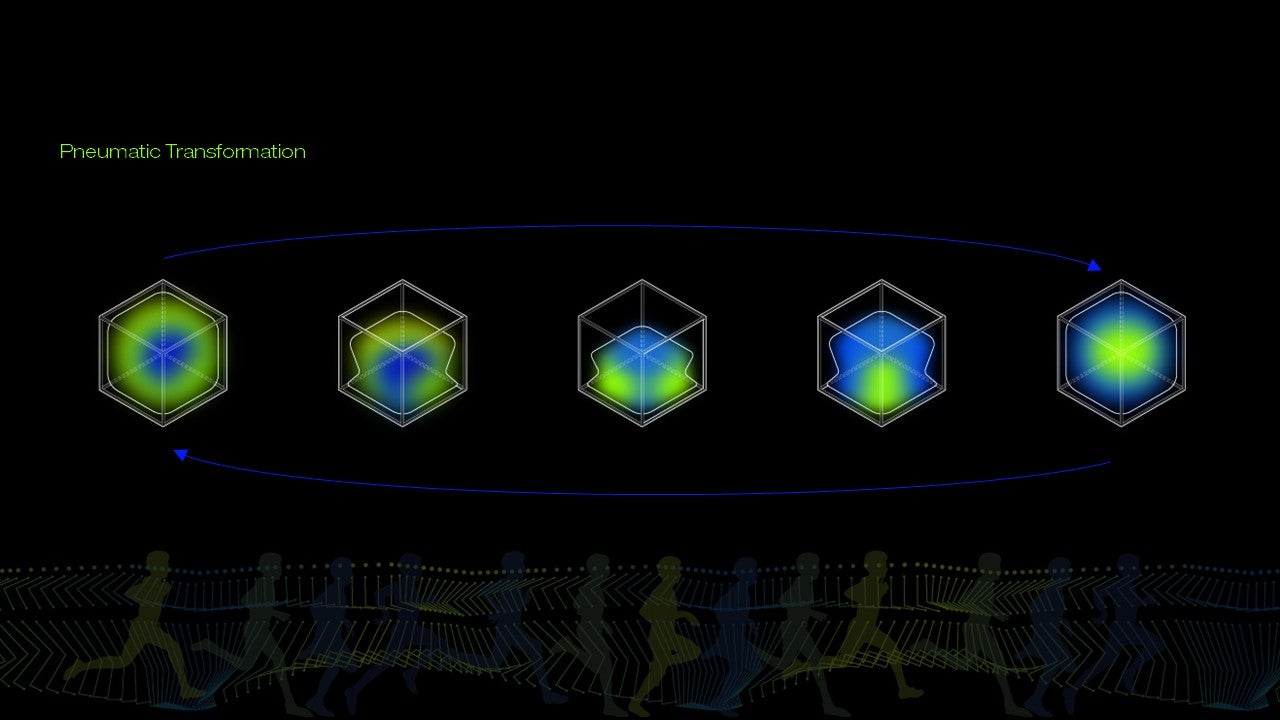
Pneumatic transformation module showing a repeated cycle of expansion and contraction. The inflatable module expands from 50% to 100% air volume and deflates in response to the runner’s respiratory rate, translating breath into spatial movement.
Image
Image

Rhode Island School of Design
20 Washington Place
Providence, RI 02913–2784
United States of America
+1 401 454 6100
+1 800 364 RISD
QUICK LINKS
risd.edu
Graduate Studies


Image
Rhode Island School of Design
20 Washington Place
Providence, RI 02913–2784
United States of America
+1 401 454 6100
+1 800 364 RISD