Ritu Mantri
MFA Graphic Design
Human After All
I respond to what is already in the world — its conditions, its contradictions, its unfinished arguments. My practice as a graphic design generalist moves across identity systems, web, archiving and world building, always balancing the distinctive with the familiar, bridging raw feeling with critical thinking. I am stimulated by everything at the intersection of design, art, culture, and technology.
My thesis, Human After All, asks a question I have spent two years circling: what does it mean to be human in a world increasingly made by and for something other than the human? Not as philosophy. Not as science. As something more urgent than either.
My work argues that the human cannot be defined — only understood as a condition of permanent entanglement. With time, with scale, with the material world, with everything it has made and everything that has made it.
Image
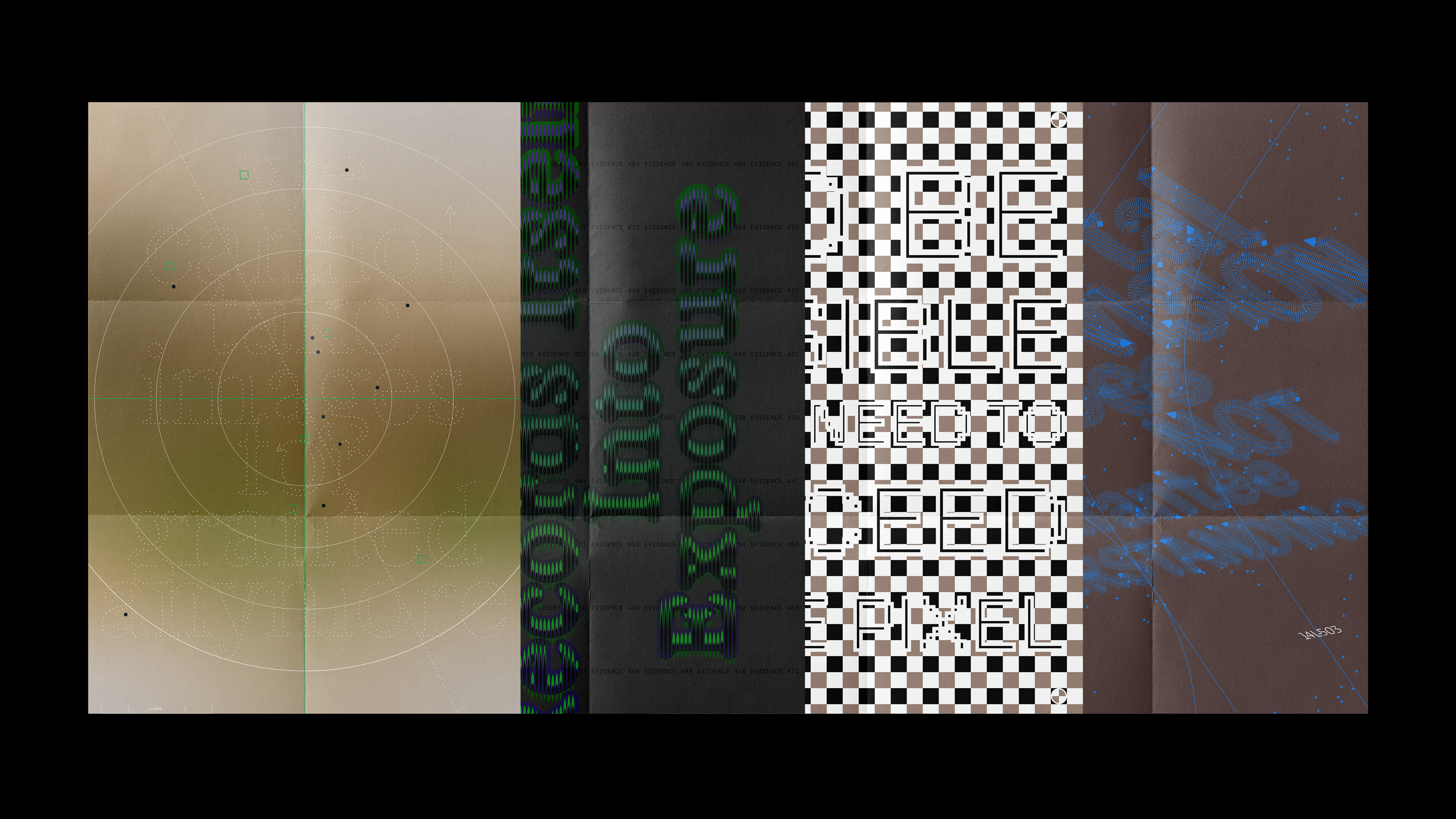
Machine Eye
Machine Eye is a meta-visual typology of the operational image — the computational layer that transforms raw sight into recognition, targeting, and decision. Across five folded typographic posters, it maps that logic through the work of artists, filmmakers, and photographers who investigate how machines see.
The argument runs from enlightenment to algorithm: for centuries, to see was to know. We built machines to inherit that principle. As Harun Farocki's work illustrates, the light machines use to see is precisely what turns vision into rational action. The eye was never neutral. Now, neither is the machine.
Image
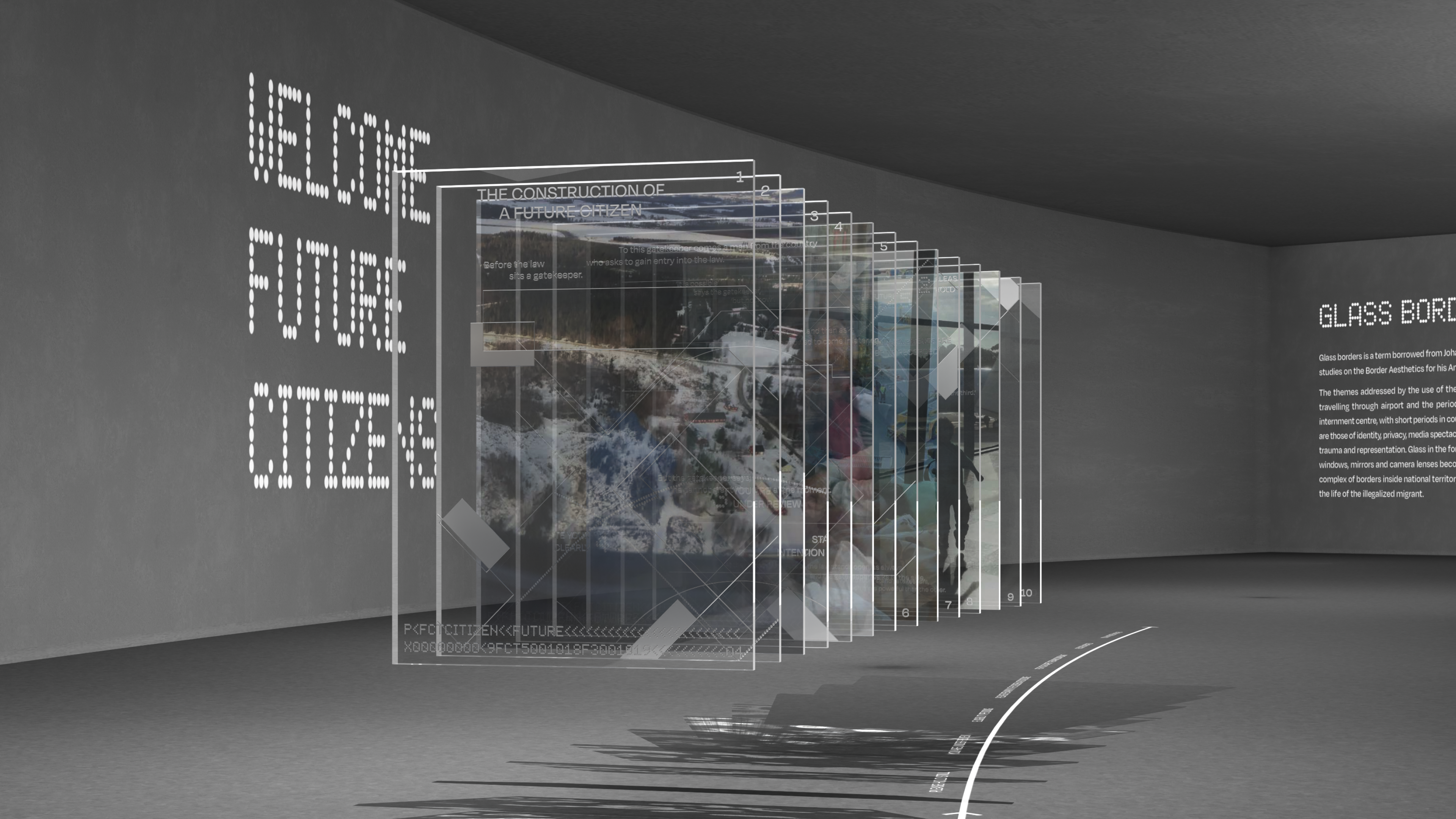
Construction of a Future Citizen
The term "Glass Borders" is borrowed from Johan Schimanski's studies on border aesthetics: glass as partition, window, mirror, and camera lens — transparent surfaces that simultaneously reveal and surveil.
The work is interested in the bureaucratic and architectural structures through which identity is constructed and verified. Each panel in the installation adds another layer of mediation between body and belonging and document and person. Pane by pane, the installation asks what it means to be seen by a system, and what remains of a person in the documents they leave behind.
Image
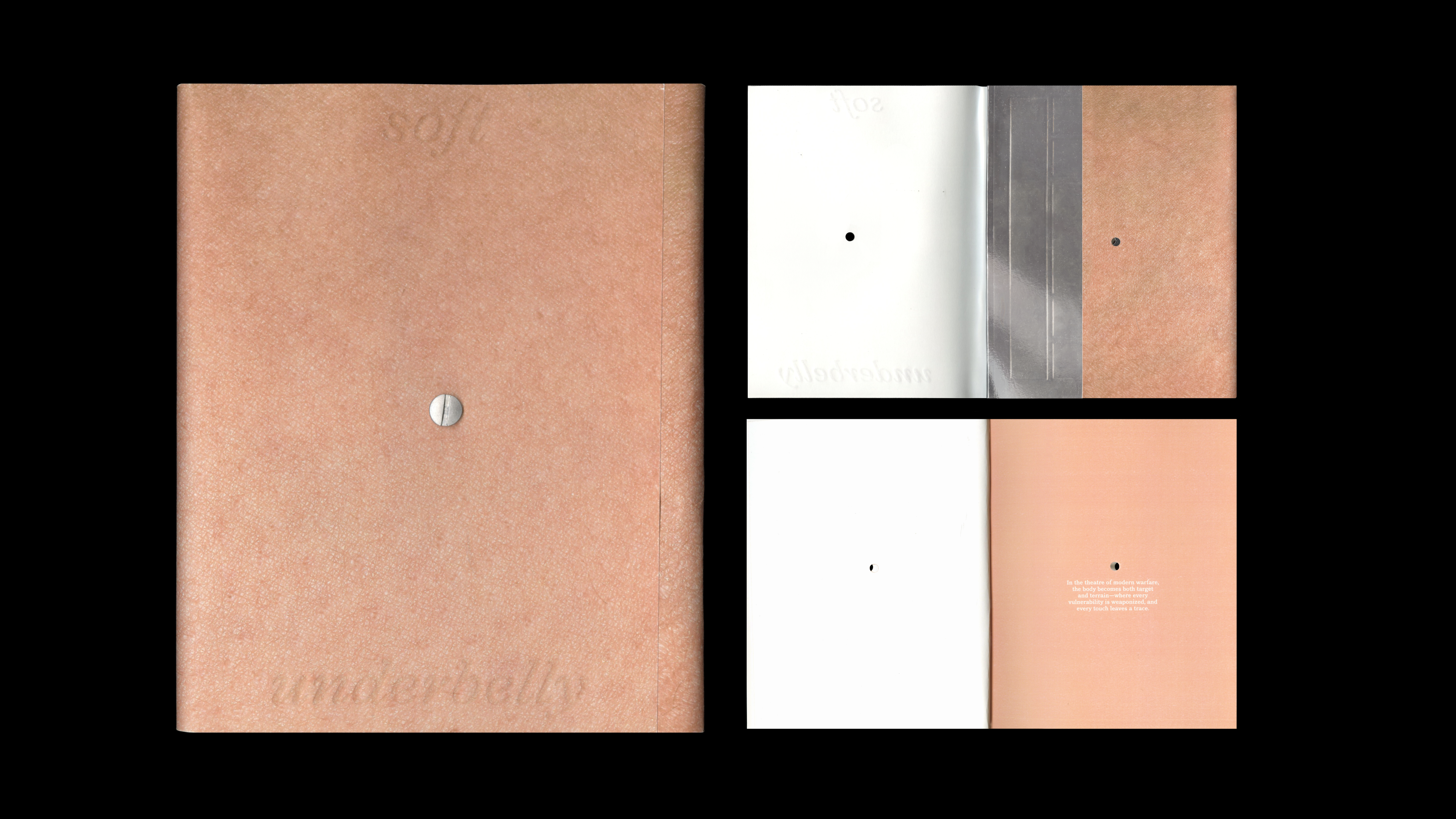
Soft Underbelly
This book is covered in a microscopic texture of an unprotected skin — debossed with its own title, fastened at center with a single chrome screw. The material already reveals the message.
Borrowing its name from wartime strategy — the most vulnerable point in an otherwise fortified system —Soft Underbelly relocates that vulnerability from geography to the body. Through a curated gathering of texts, it maps the exposed zones of contemporary life: surveillance, overstimulation, fragmentation, inherited trauma.
This book also functions as a reflective surface, asking readers to find themselves within what they are reading. Held in the hands, its skin-like cover already implicates you. To open it is to recognize: the underbelly it describes may be your own.
Video file
Is Data Ephemeral?
A time-lapse of a lily collapsing across frames — from a full, glitching bloom fragmented with white digital artifacts, to a sealed yellow-green pod. The green stem persists as the flower unmakes itself, left to right, top to bottom.
The work sits at the edge of the organic and the computational. The glitching is not incidental. It argues: what reads as data loss is also natural decay, and the two processes become indistinguishable. These distorted, fragmented images ask what we lose when we mistake capture for keeping, and whether our digital creations are any less mortal than the living things they document.
Image

Rhode Island School of Design
20 Washington Place
Providence, RI 02913–2784
United States of America
+1 401 454 6100
+1 800 364 RISD
QUICK LINKS
risd.edu
Graduate Studies


Image
Rhode Island School of Design
20 Washington Place
Providence, RI 02913–2784
United States of America
+1 401 454 6100
+1 800 364 RISD