Sheetal Agrawal
MID Industrial Design
Sentience
The increasing urgency for adaptive systems has driven research toward embedding intelligence directly into materials rather than relying solely on external sensing and control systems. My thesis explores how smart materialF embedded systems can be designed to recognize and respond to environmental signatures, defined as measurable patterns such as temperature fluctuations and mechanical forces. Central to this investigation is the integration of shape memory alloys, particularly Nitinol, with geometry-based actuation mechanisms that amplify material behavior into functional system responses.
This research develops a framework that merges material science, computational design, and environmental responsiveness. Through theoretical analysis and material characterization, my research demonstrates how intrinsic material properties can serve as both sensor and actuator, enabling passive or low-energy adaptive systems. The thesis contributes to a broader paradigm shift toward material intelligence and offers a foundation for future interdisciplinary innovation from micro to macro scale.
Image
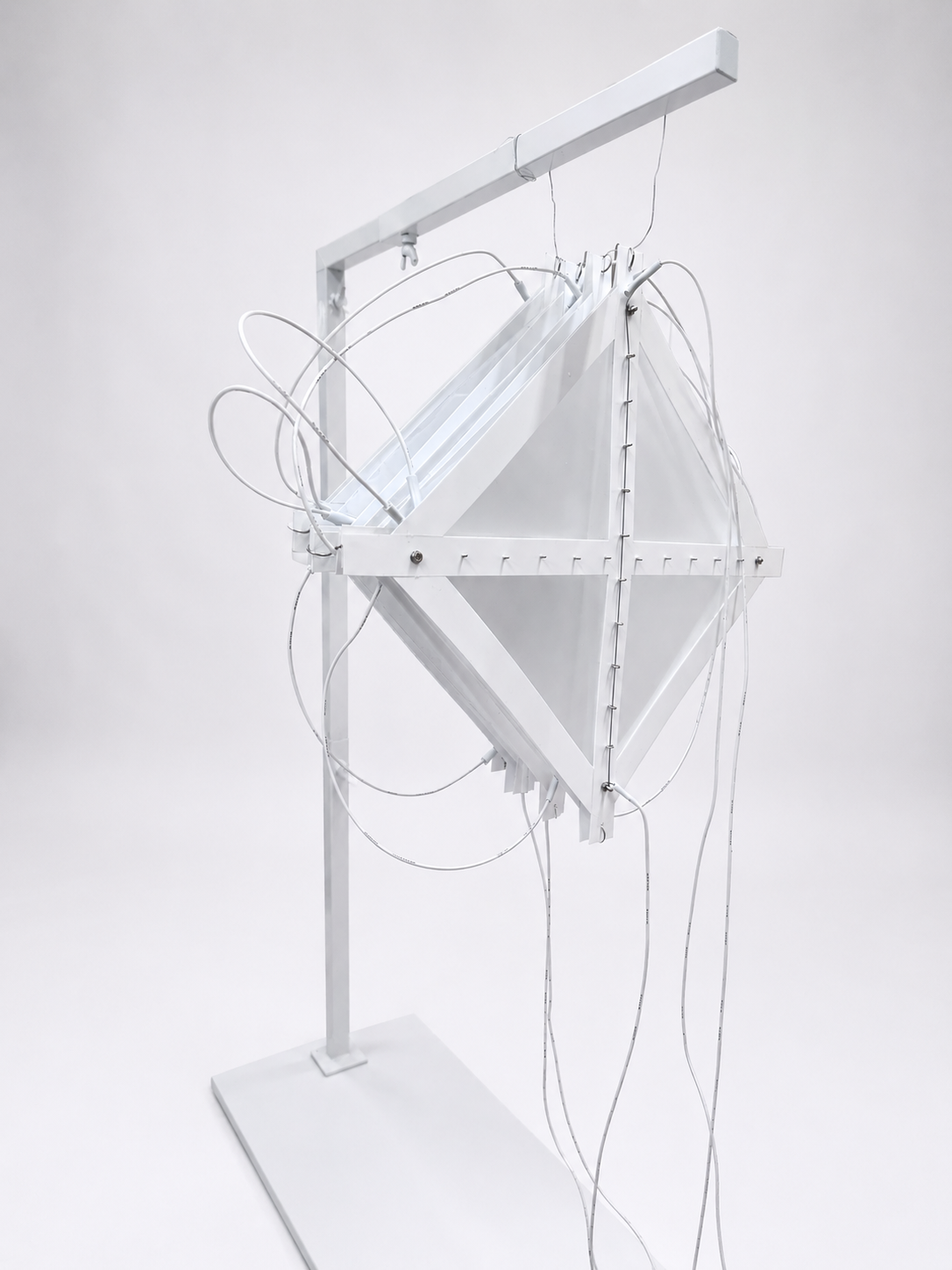
Amphimorph
Amphimorph is an assembled structure capable of bidirectional actuation, made possible by surfaces embedded with Shape Memory Alloy wire. Unlike traditional actuators that move in a single direction, Amphimorph is designed to actively move both ways, bending and shifting in response to heat.
The name reflects this dual nature, the structure exists in a designed tension between two distinct states, with embedded Shape Memory Alloy driving each transition. What makes Amphimorph compelling is that this actuation is entirely intrinsic. There are no motors, no pneumatics, no external controls just the thermally responsive behavior of the wire working in concert with the geometry of the surfaces themselves. The surfaces aren't simply carriers for the wire; they're active participants in shaping where and how deformation occurs, making Amphimorph a tangible demonstration of material intelligence in action.
Image
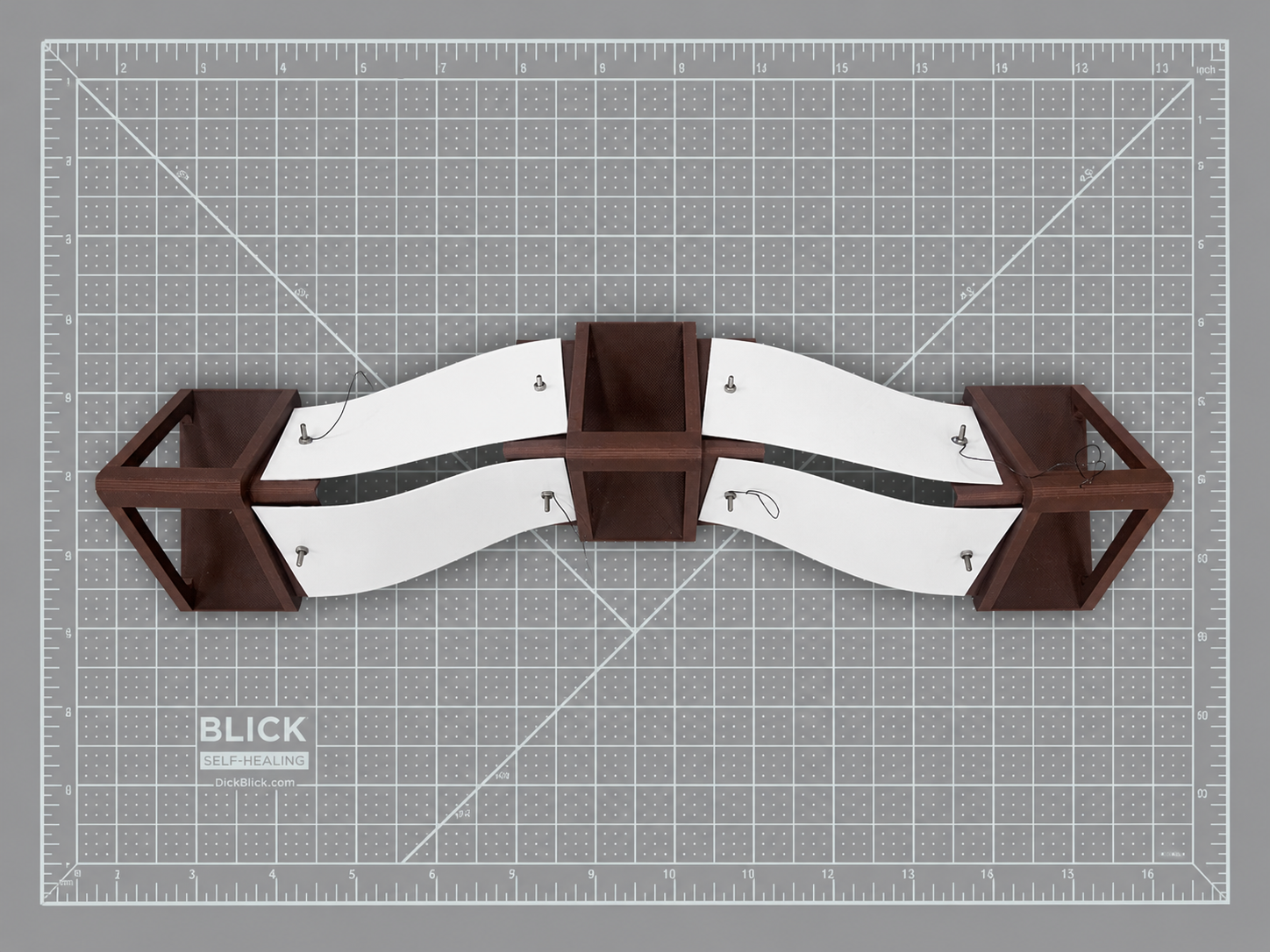
Vermis
Vermis is a crawler that uses shape memory wire to generate directional movement through a "pull" based locomotion mechanism. Drawing inspiration from the way soft-bodied creatures like worms navigate their environment, Vermis contracts and extends along a single axis, inching forward through the repeated, coordinated activation of its embedded Nitinol wire.
When heat is applied, the shape memory wire contracts, pulling the body of the structure forward. As it cools, the wire returns to its extended state, resetting for the next cycle. This rhythmic contraction and release is what drives Vermis along a surface. This makes it lightweight, scalable, and well-suited for environments where conventional motors simply wouldn't fit.
Image

Rhode Island School of Design
20 Washington Place
Providence, RI 02913–2784
United States of America
+1 401 454 6100
+1 800 364 RISD
QUICK LINKS
risd.edu
Graduate Studies


Image
Rhode Island School of Design
20 Washington Place
Providence, RI 02913–2784
United States of America
+1 401 454 6100
+1 800 364 RISD