Xinyi (Joanna) Li
MFA Jewelry + Metalsmithing
Specific Randomness
Stability is never the default. It has to be actively produced.
My work grows out of precarity, the condition where everything around me functions and none of it is guaranteed. I use computational tools to set rules on source images where multiple constrained processes operate at once, each following its own logic, with no unified system holding them together. The rules I define do not eliminate irregularity. They determine the range within which it can persist. The resulting forms are realized as jewelry through 3D printing and manual metalwork, then worn on a living body that never stops regulating its own continuation.
What these pieces record is not a resolved form. They record the ongoing activity of construction under conditions that were never stable.
Each piece is finished by hand, in front of the printed object. The algorithm sets the boundaries within which forms can exist. It does not know how those forms meet the body, how the patterned variation reads under color, or whether the result has reached the density it was supposed to reach. Those decisions can only happen in the studio, with the object in front of me. The hand answers questions the algorithm cannot ask.
This work does not propose a solution to precarity. It proposes a way of continuing within it.
Image
Churn
2026
PLA, silver; 3D printing, paint, metalsmithing
Necklace, 170 × 130 × 35 mm
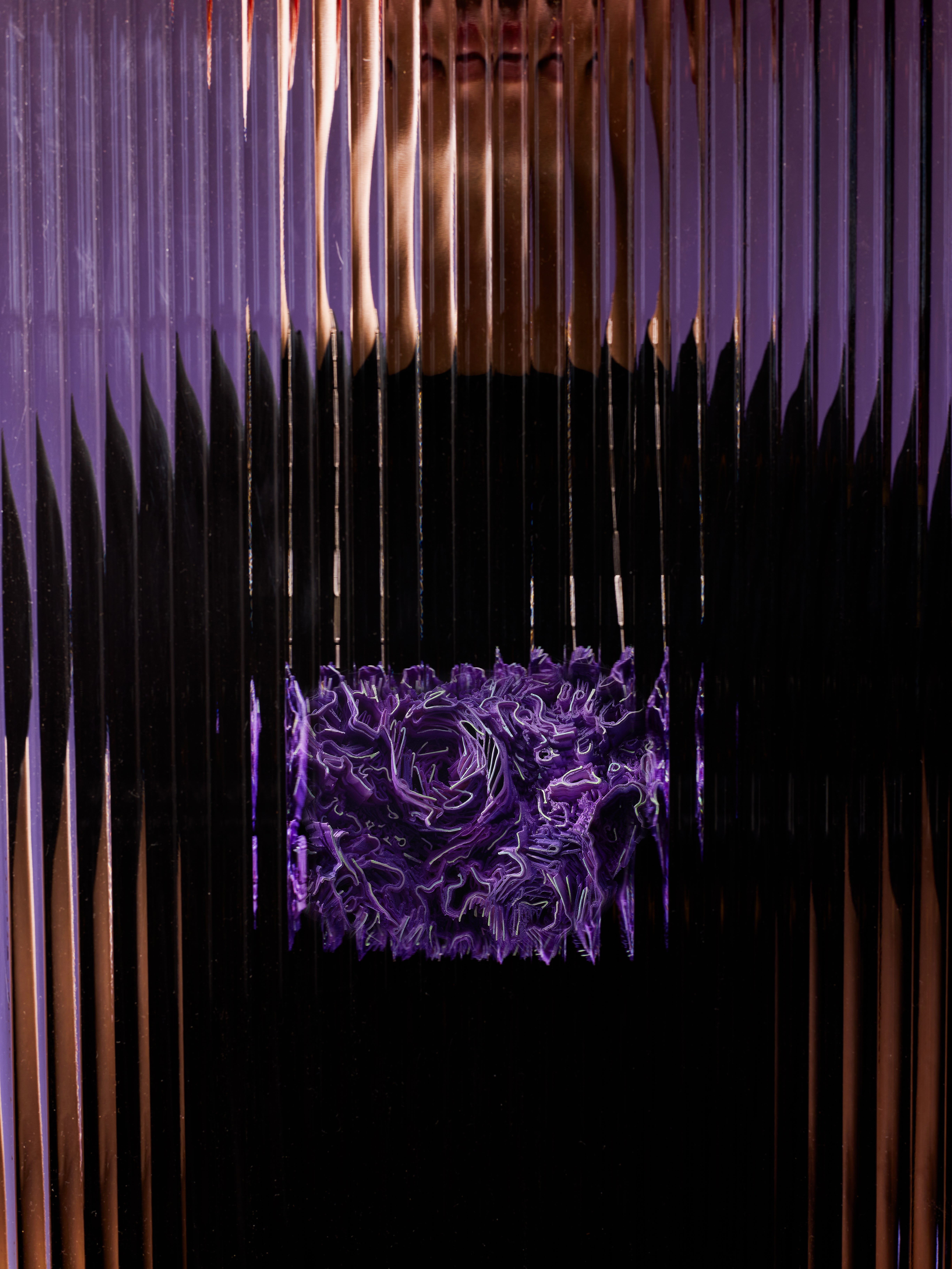
Churn came off the printer with the patterned surface fully developed and a flat back. I heated the piece and reshaped it by hand to follow the curve of the chest, then extended the surface logic into the back so the directional flow that crosses the front continues around. The color went through several attempts. Two-tone dyeing flattened the structure. I worked instead in a single hue at multiple depths of saturation, then added highlights at the raised points to catch light differently. The motion came back. The result is a surface that holds wall-like forms rising and falling under a sense of directional flow.
Image
Draw
2026
PLA, silver; 3D printing, paint, metalsmithing
Necklace, 130 × 80 × 15 mm
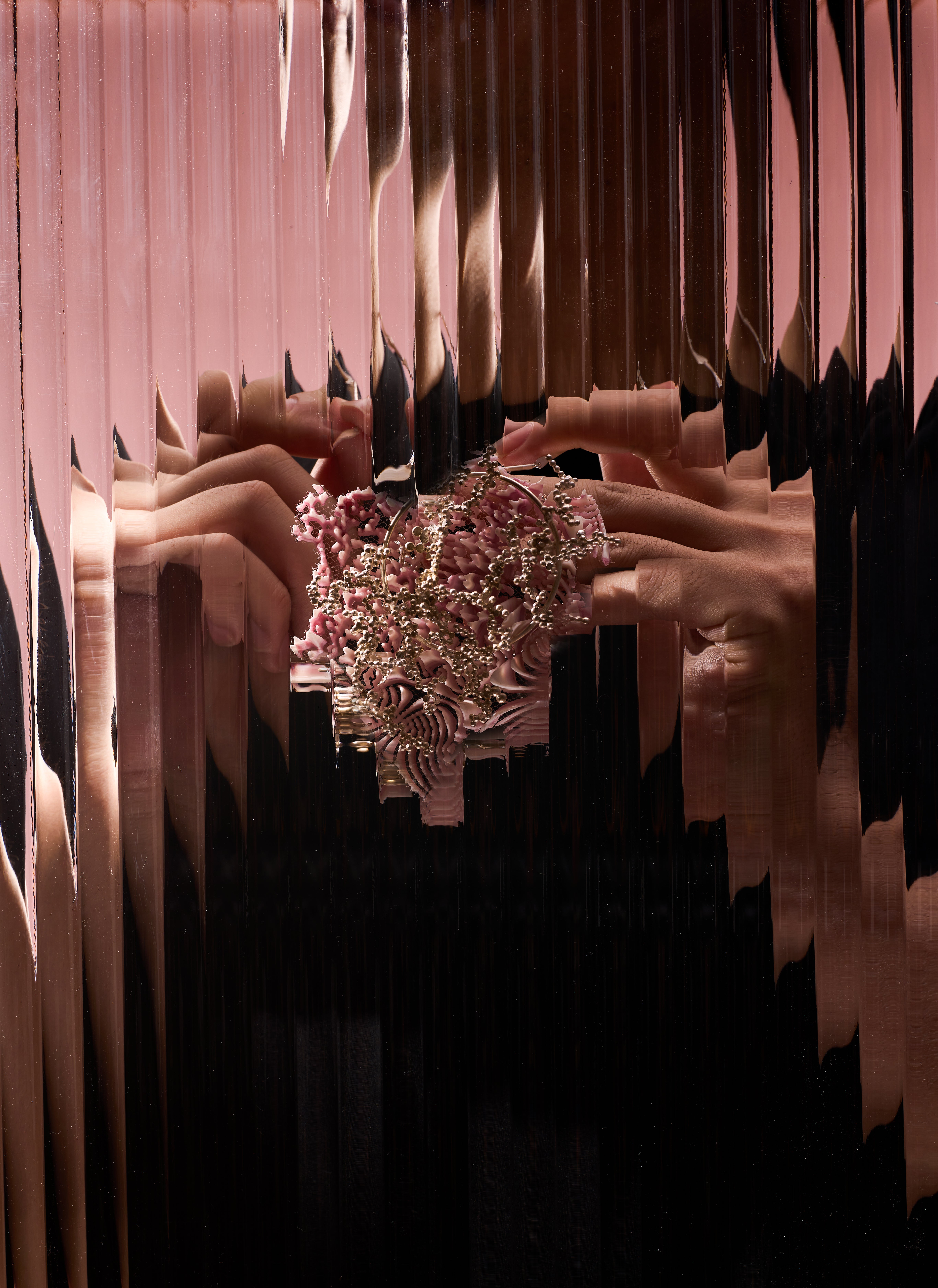
Draw covers a printed surface with hand-applied silver granulation. The granules trace lines across the form, drawing a separate logic over the patterned base beneath them. The two layers do not merge. The silver follows its own rhythm, partly responding to the surface it sits on, partly running counter to it. The piece is the smallest in the series and demands the closest looking, since the relationship between the layers only becomes visible at very short range.
Image
Image
Encrust
2026
PETG, foam, silver; 3D printing, sewing, metalsmithing
Necklace, 460 × 280 × 90 mm
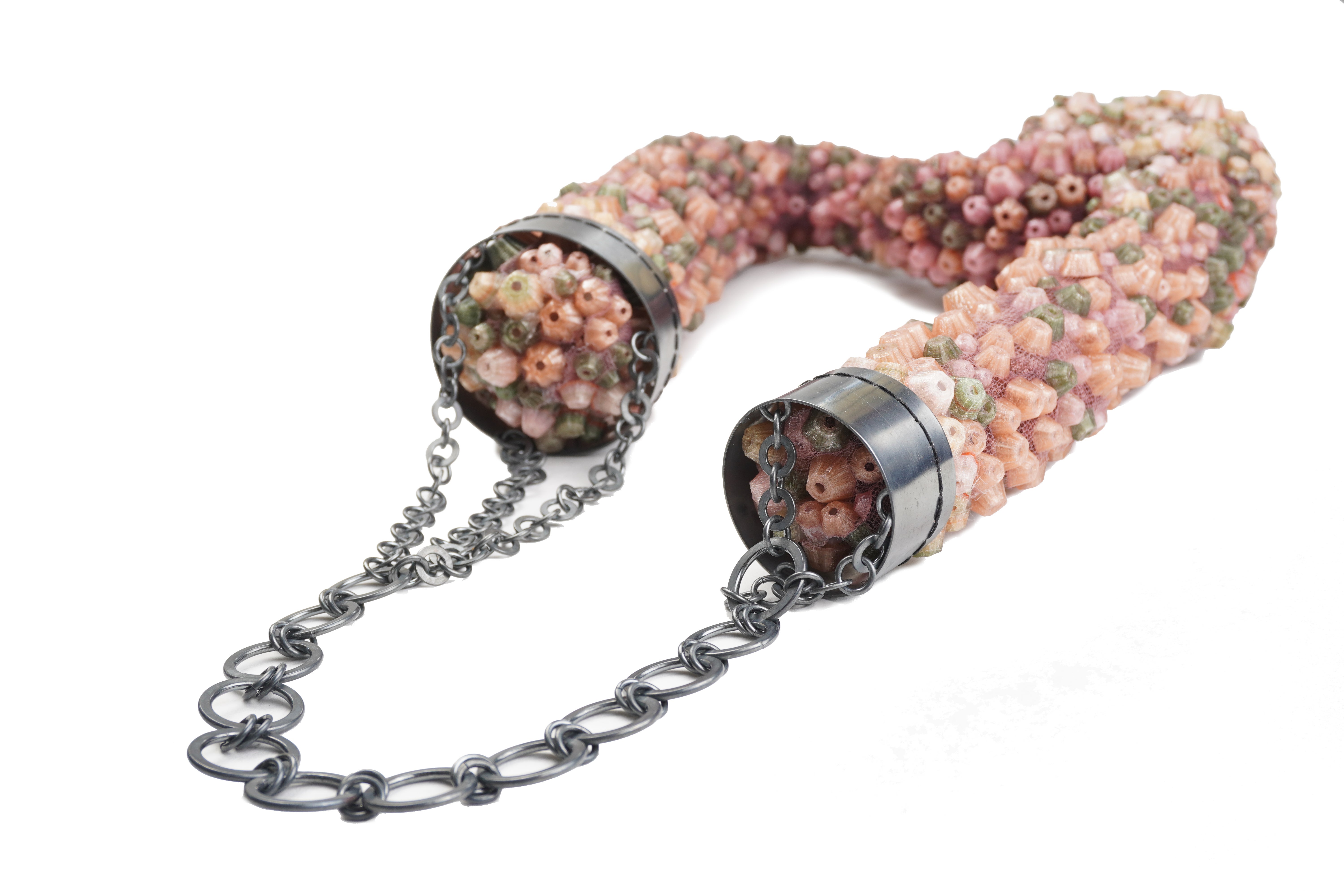
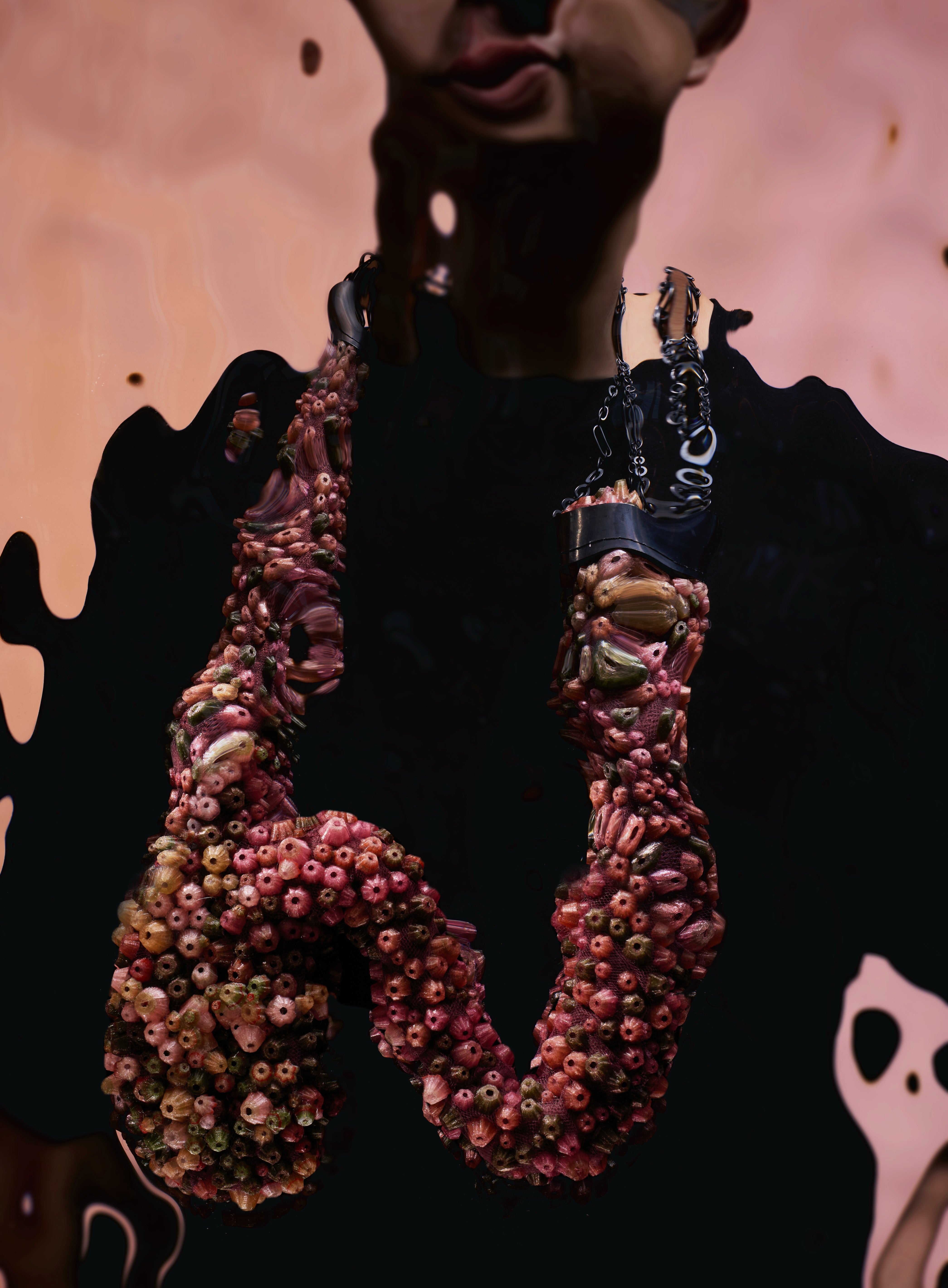
Encrust is the largest piece in the series and the one where the original plan failed. I designed it as a sculpted foam form covered with printed mesh sections holding clustered small forms, sewn onto the foam by hand. After printing and assembling ten panels, I could not produce the density I needed. I cut away the upper portion that was not working and replaced it with an oxidized silver chain, sewn directly into what remained. The chain ends the gradient where the gradient could no longer continue, and introduces a constraint that reads as binding rather than continuation. The piece records the moment of staying in front of the object long enough to see what it actually wanted, which turned out to be different from what I had wanted for it.
Image
Image
Swell
2026
PLA; 3D printing
Arm cuff, 175 × 165 × 100 mm
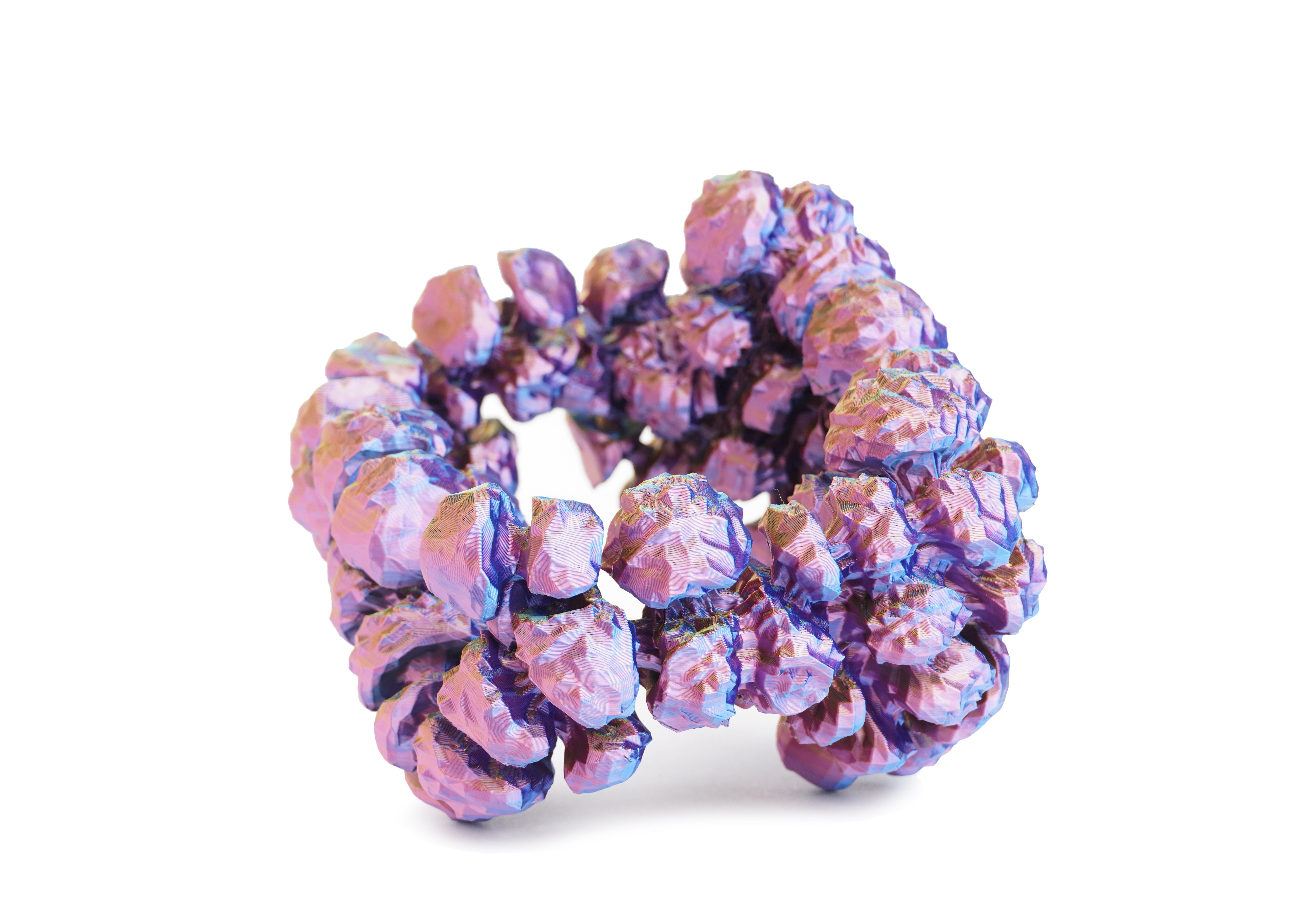
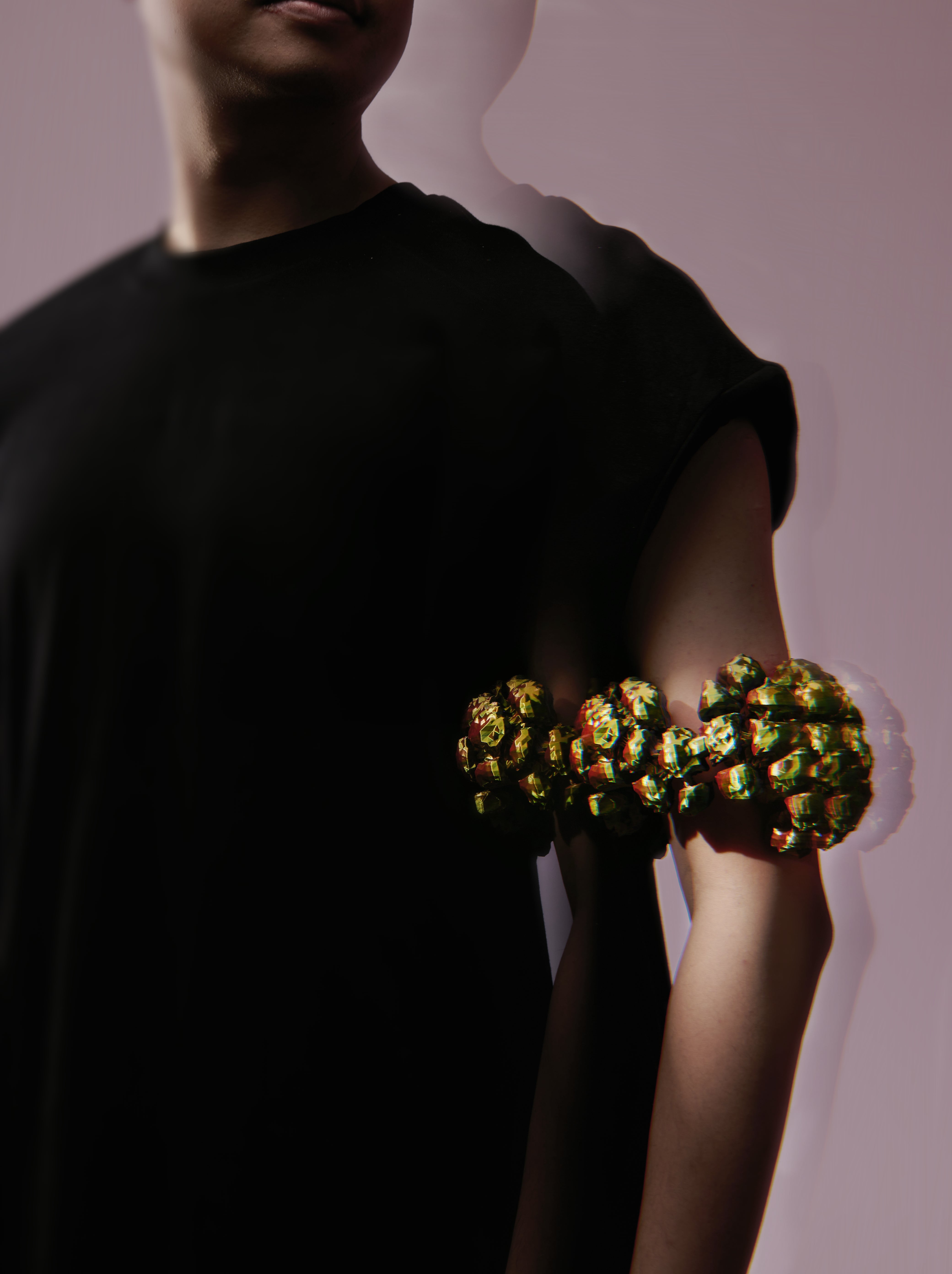
Swell is the only piece in the series that holds its color through tricolor printing rather than post-print dyeing. The form is built from clustered rounded volumes that swell outward from the cuff, each one carrying the iridescent purple-pink-blue shift of the filament. Worn on the upper arm, the piece sits as a band of accumulated mass that visibly responds to the body’s movement. It is also the only piece in the series that does not pass through manual finishing after printing. The color and surface are what came off the machine.
Image
Image
Warp
2026
PLA, silver; 3D printing, paint, metalsmithing, casting
Bracelet, 200 × 60 × 10 mm
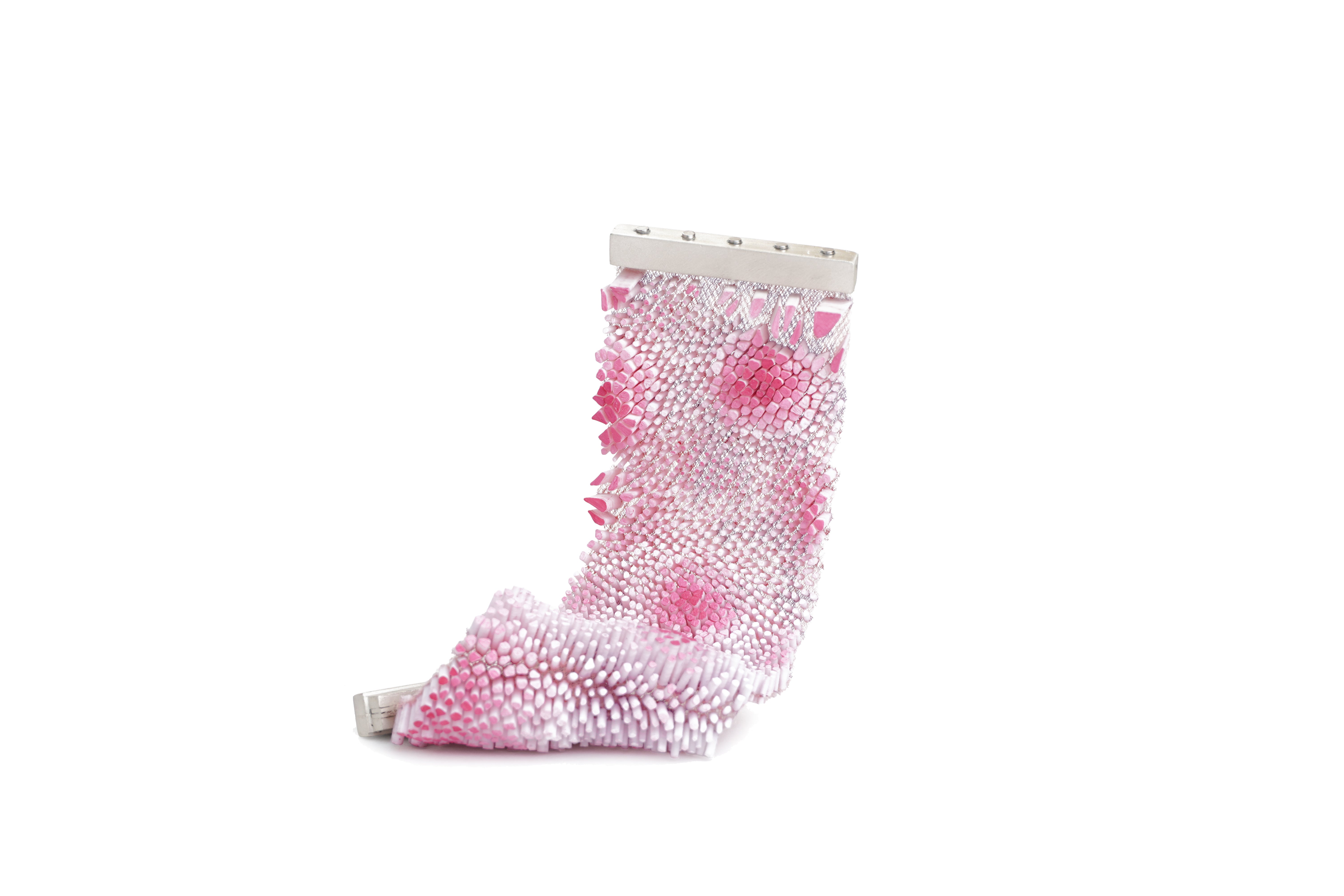
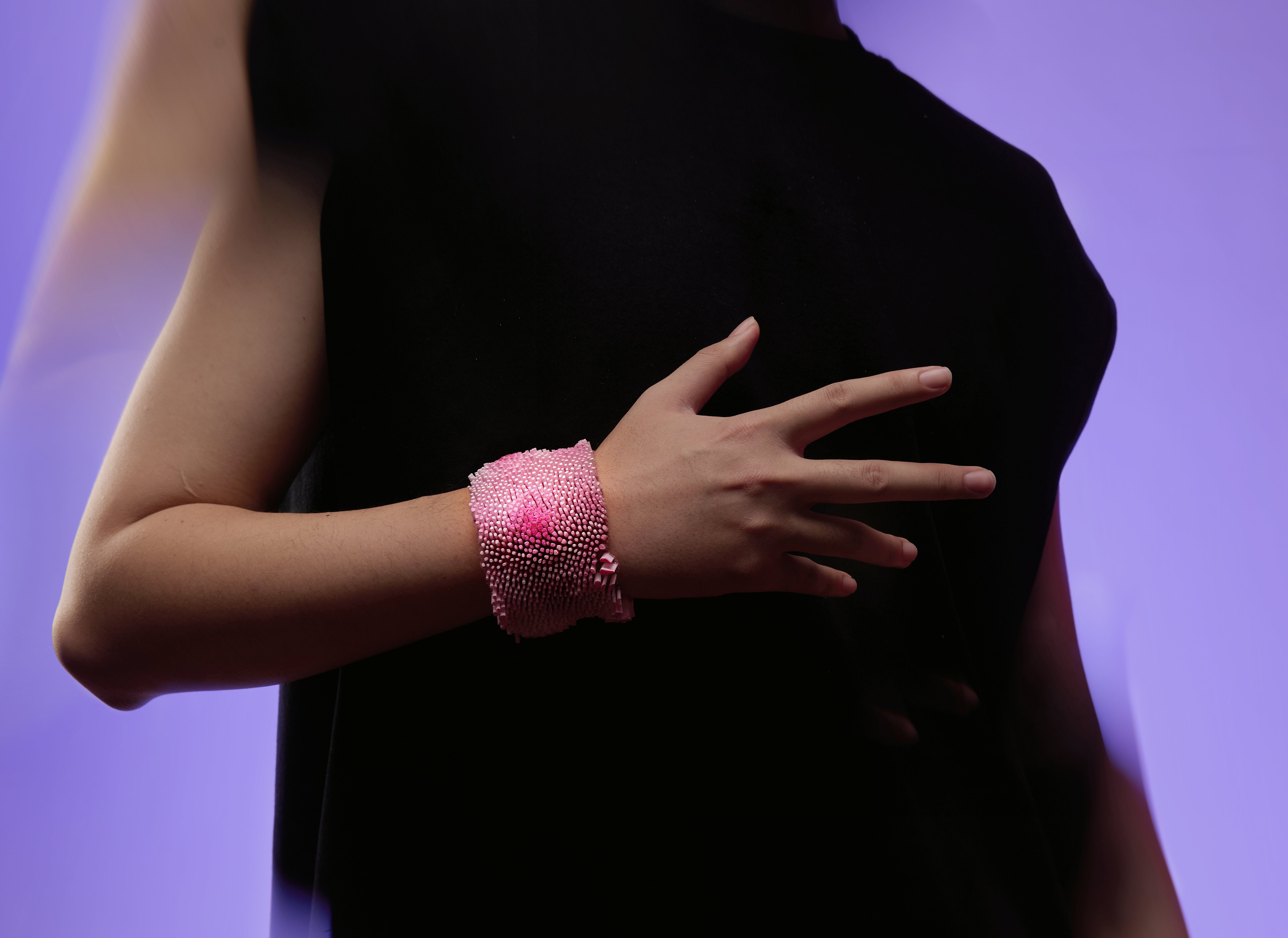
Warp came off the printer soft and flexible. The flexibility told me it should be a bracelet rather than a brooch. The piece is a field of small upright elements, each one separate from the others, printed onto mesh so they hold together as a surface without bonding into a continuous form. Worn on the wrist, the elements shift slightly against each other; the population stays a population. The color came after the form. Pigment pooled and faded in places the print had not anticipated, and I worked with this rather than correcting it, adding finer surface treatments that pulled the depth into focus."
Image

Rhode Island School of Design
20 Washington Place
Providence, RI 02913–2784
United States of America
+1 401 454 6100
+1 800 364 RISD
QUICK LINKS
risd.edu
Graduate Studies


Image
Rhode Island School of Design
20 Washington Place
Providence, RI 02913–2784
United States of America
+1 401 454 6100
+1 800 364 RISD